
Auction 98 · Lot 98
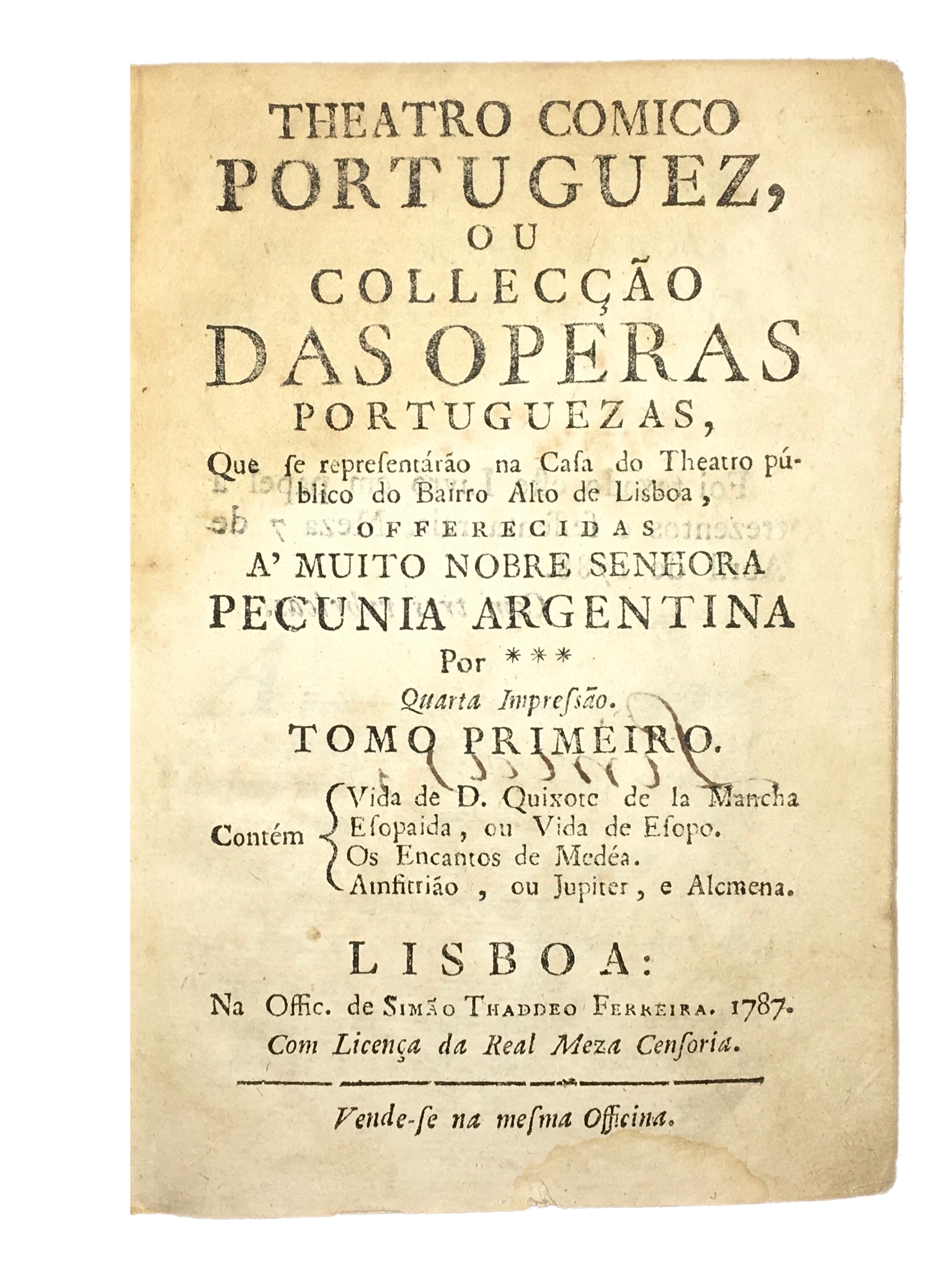
(António José da Silva Coutinho). Theatro Comico Portuguez.
- Estimate
- $2,000–$3,000
- Hammer price
- Not recorded
Historical auction record. Hammer prices exclude buyer’s premium and taxes.
author
(BRAZIL).
printer
Simão Thaddeo Ferreira
Place
Lisbon
Publication
1787, 1788, 1790, 1792
Description
First edition. Complete in four volumes.
summary
The first two volumes of this 4-volume set “Theatro Comico Portuguez” comprise works penned exclusively by the celebrated Brazilian Jewish playwright Antônio José da Silva (1705-39). It includes his most widely praised play "Vida de D. Quixote. Also: Esopaida, ou vida de Esopo * Os encantos de Medéa * and Amfitrião, ou Jupiter, e Alcmena.
Da Silva, known as “O Judeu” (Port. “The Jew”), wrote comedies, farces, and operettas which revitalized the Portuguese theater during a period of dramatic decadence.
Born in Rio de Janeiro of Jewish extraction, Antônio José da Silva was seven years old when his mother was accused by the Inquisition of relapsing into Judaism, whereupon the family was forced to leave Brazil for Portugal for her trial. Da Silva studied canon law at Coimbra, but aged 21 was imprisoned along with his mother and brothers and forced under torture to abjure his Jewish faith. Upon his release, he completed his studies (1728), joined his father’s legal practice in Lisbon, and married a cousin who had also suffered religious persecution.
During a brief period (1729-37) when he was unmolested by the authorities, Da Silva wrote eight plays, all for the ópera dos bonecos (puppet theater) and performed at the Bairro Alto Theatre in Lisbon. Prose dialogue is interspersed with arias, minuets, and modinhas (popular, light songs). His best plays are generally considered to constitute a skilled and witty satire against the pretensions of a society based upon caste and privilege.
In 1739 Da Silva and his wife were both charged by the Inquisition with the heresy of Judaizing and imprisoned on October 5th. Thirteen days later, Silva was garrotted and burned at an auto-da-fé (public burning at the stake), witnessed by his wife, who died soon thereafter.
See https://www.britannica.com/biography/Antonio-Jose-da-Silva and https://en.wikipedia.org/wiki/Ant%C3%B3nio_Jos%C3%A9_da_Silva.
pp. 426, (4). * 468, (4). *382, (1). * 338, (2). Trace browned, previous owner’s marks. Contemporary mottled calf, rubbed. 8vo.