
Auction 94 · Lot 390
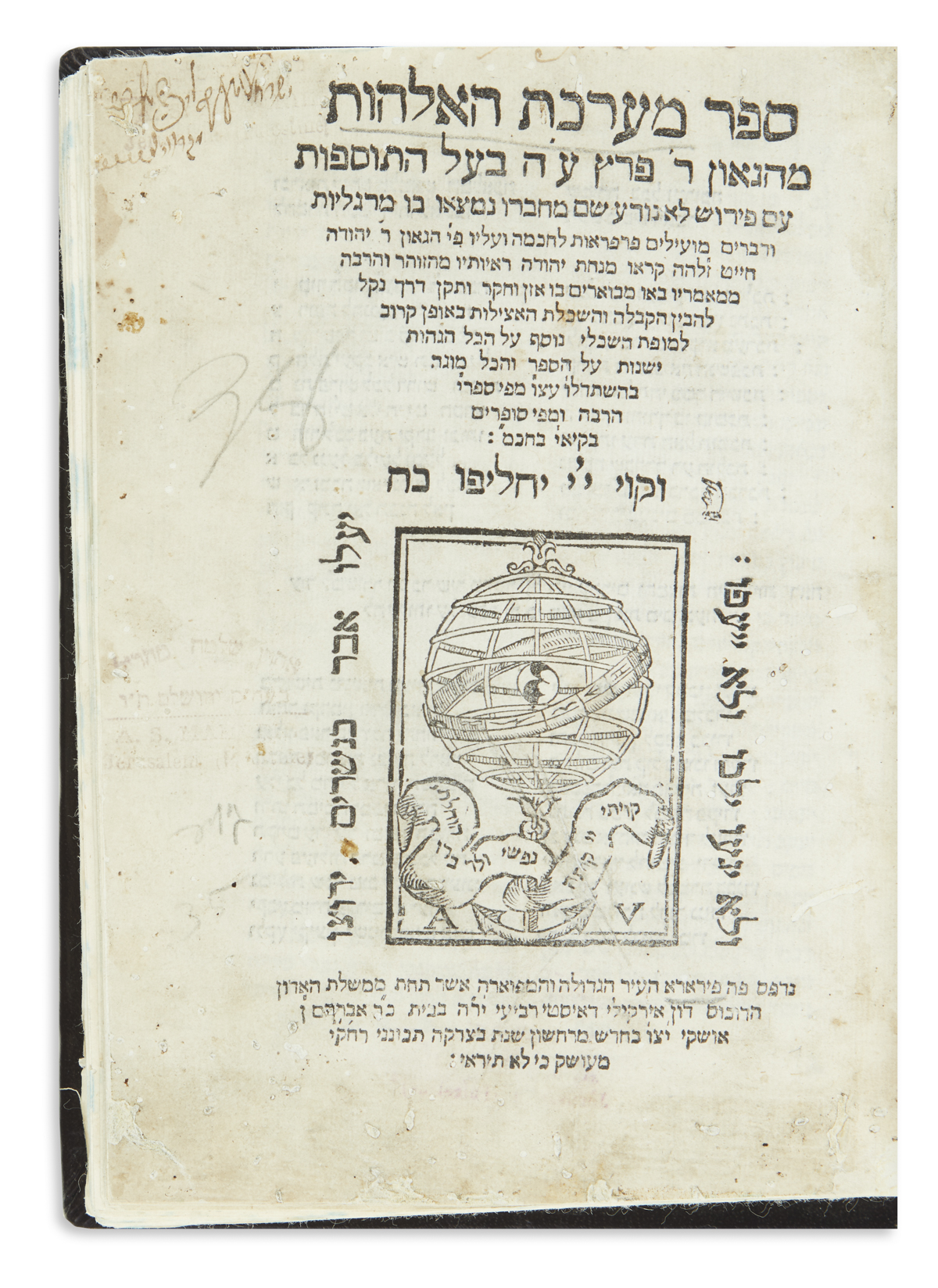
(Attributed to). Ma’arecheth Ha’Elo-huth [Kabbalah]. With commentary by the Italian mystic Judah Chayat and another (see below).
- Estimate
- $4,000–$5,000
- Hammer price
- Not recorded
Historical auction record. Hammer prices exclude buyer’s premium and taxes.
author
PERETZ BEN ISAAC HAKOHEN
printer
Abraham ibn Usque
Place
Ferrara
Publication
1558
Description
FIRST EDITION. Printer’s mark on title: An astrolabe and verse from Isaiah 40:31 (Yaari, no. 22). A wide-margined copy. With stamps of R. Aharon Shlomo Maharil (see below).
references
Vinograd, Ferrara 49 (mispaginated).
summary
One of the most significant works on the Kabbalah due to its systematic treatment of all relevant themes found in earlier literature. Its contribution to speculative mystic theory in pre-Zoharite Kabbalistic literature is the increased symbolism of the Sephiroth. The author quotes a multitude of names by which each Sephirah is known, each signifying a differing function. He also develops the “Adam Kadmon” theory, whereby the likeness of the order of the Divine Powers of the Sephiroth to the human body is explored.
In the same year of 1558, two editions of Ma’arecheth Ha’Elo-huth appeared, one in Ferrara, the other in Mantua. In the present Ferrara edition, the anonymous commentary is designated simply “Peirush,” whereas in the Mantua edition it bears the initials Pa”Z, for “Peirush Zulath” (Another Commentary). According to Scholem, the Ferrara version of the commentary has several important passages lacking in the Mantua edition; see Studies in Kabbalah I (Tel Aviv, 1998) p. 176.
Rosh Yeshivah of Shaar HaShamayim, Rabbi Aharon Shlomo Maharil was a prominent Kabbalist in Lithuania. Following his death after decades in Jerusalem, he was buried right alongside his master, the extraordinary Kabbalist, R. Shlomo Elyashiv (The Leshem).
ff. (6), 286. Touch stained, previous owner’s inscriptions, occasional neat paper repairs, closing leaves remargined. Modern calf. 4to.
Enquire about this lot