
Auction 90 · Lot 216
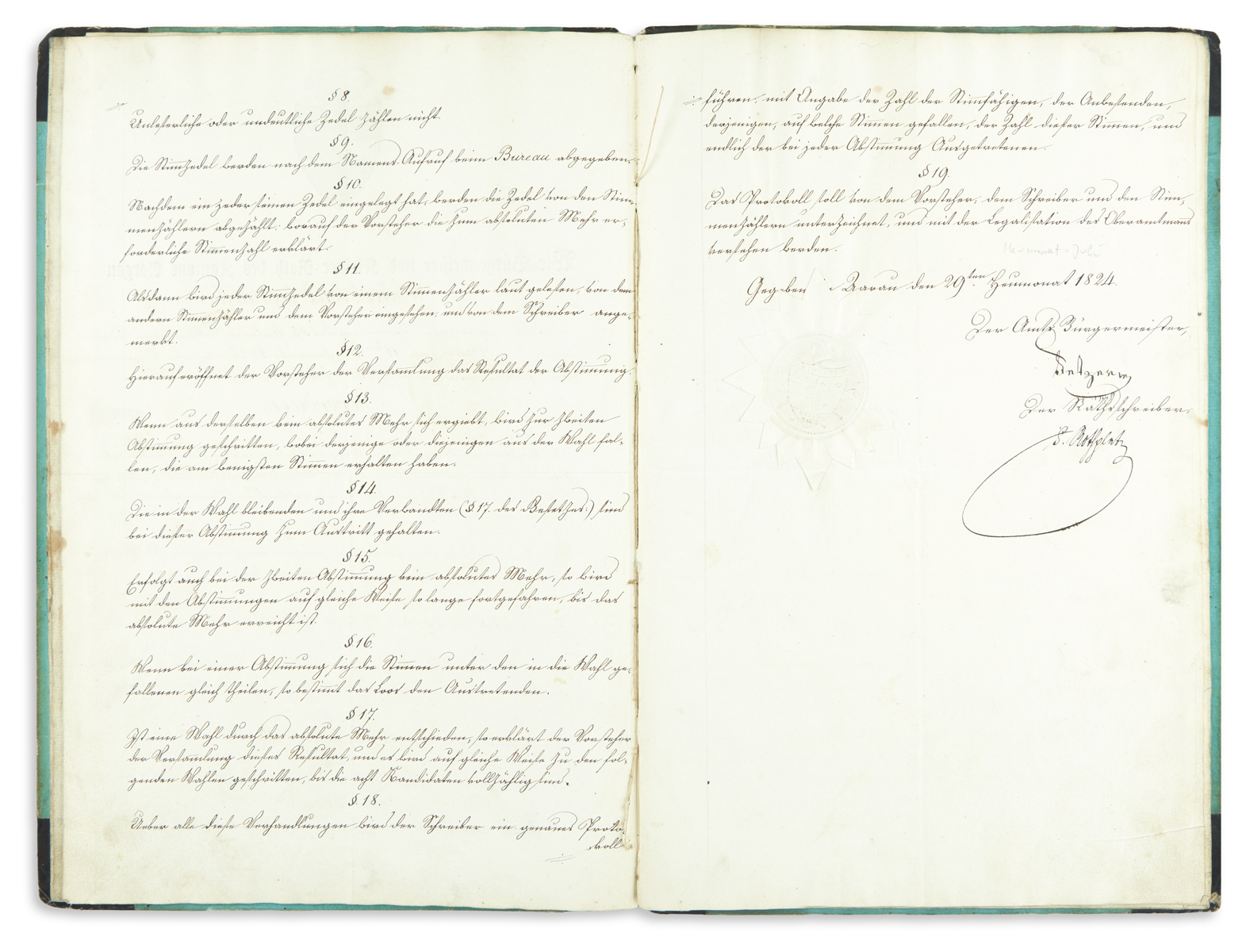
Gesetz und Verordnungen über Organisation der Jüdischen Gemeinden Endingen u. Lengnau, vom 11. Brachmont 1824 [“Law and Ordinances on the Organization of the Jewish Communities of Endingen and Lengnau.”]
- Estimate
- $2,000–$3,000
- Hammer price
- $2,800
Historical auction record. Hammer prices exclude buyer’s premium and taxes.
author
(SWITZERLAND).
printer
11th June
Place
Switzerland
Publication
1824
Description
Secretarial Manuscript in German, with autograph signatures (mayor and council clerk).
summary
Manuscript copy of the Organizational Law of 1824 of the Canton of Aargau that reorganized the Jewish communities in Endingen and Lengnau on the same principles as those governing similar non-Jewish institutions in the canton.
Between the 17th and 19th centuries, the Jews of Switzerland were allowed to live only in one of the two villages of Endingen and Lengnau, which were located in the canton of Aargau, some 18 miles northwest of Zurich. At the close of the 18th-century, the 553 Jews in these villages represented almost the entire Jewish population in Switzerland.
The 1824 law recognized the Jewish communities as corporations, but also ended their communal autonomy. Four governing factors were laid down in this Organizational Law: The character of the Jewish community as financially independent, the form of their administration, their educational system, and the establishment of an internal judicial system.
The two Jewish communities were to be financed entirely on their own and could not expect any support from the canton. In relation to the state however, they formed a united corporation which could have common funds for schools and religious institutions in order to fulfill larger tasks. In particular, they were jointly obliged to provide for the maintenance of their impoverished fellow-members, again, without the expectation of any assistance from the public authorities.
The rabbi and the administrative leadership of the Jewish community (to be nominated by the government of the canton) were obliged to form a court-system, that would act as a guardian of good morals. The court was to be responsible for married couples living in discord, wayward children and pupils who neglected their school-lessons. The court also sat in judgment against anyone who disturbed the Sabbath, on drunkards, gamblers, and profligates, and it ensured that the youth were educated to become useful craftsmen and tradesmen.
Overall, the law of the year 1824 finally made it unquestionable that the Jews were upstanding members of the canton - but only as a minor class. They had the right of residence in their communities, but without the right to be a cantonal citizen and thus a full-fledged Swiss citizen. Altogether, the law of 1824 was an important step towards the emancipation of Jews in Switzerland. It was not until 1866 that freedom of residence was granted, with full civil equality extended to Jews only in 1876.
See F. Guggenheim-Grünberg, Geschichte der Juden in der Schweiz vom 16. Jahrhundert bis nachder Emanzipation (1966) pp. 159-69.
pp. 15 (excluding blanks). Original green boards, gutter split, stain on upper cover. Folio.
Enquire about this lot