
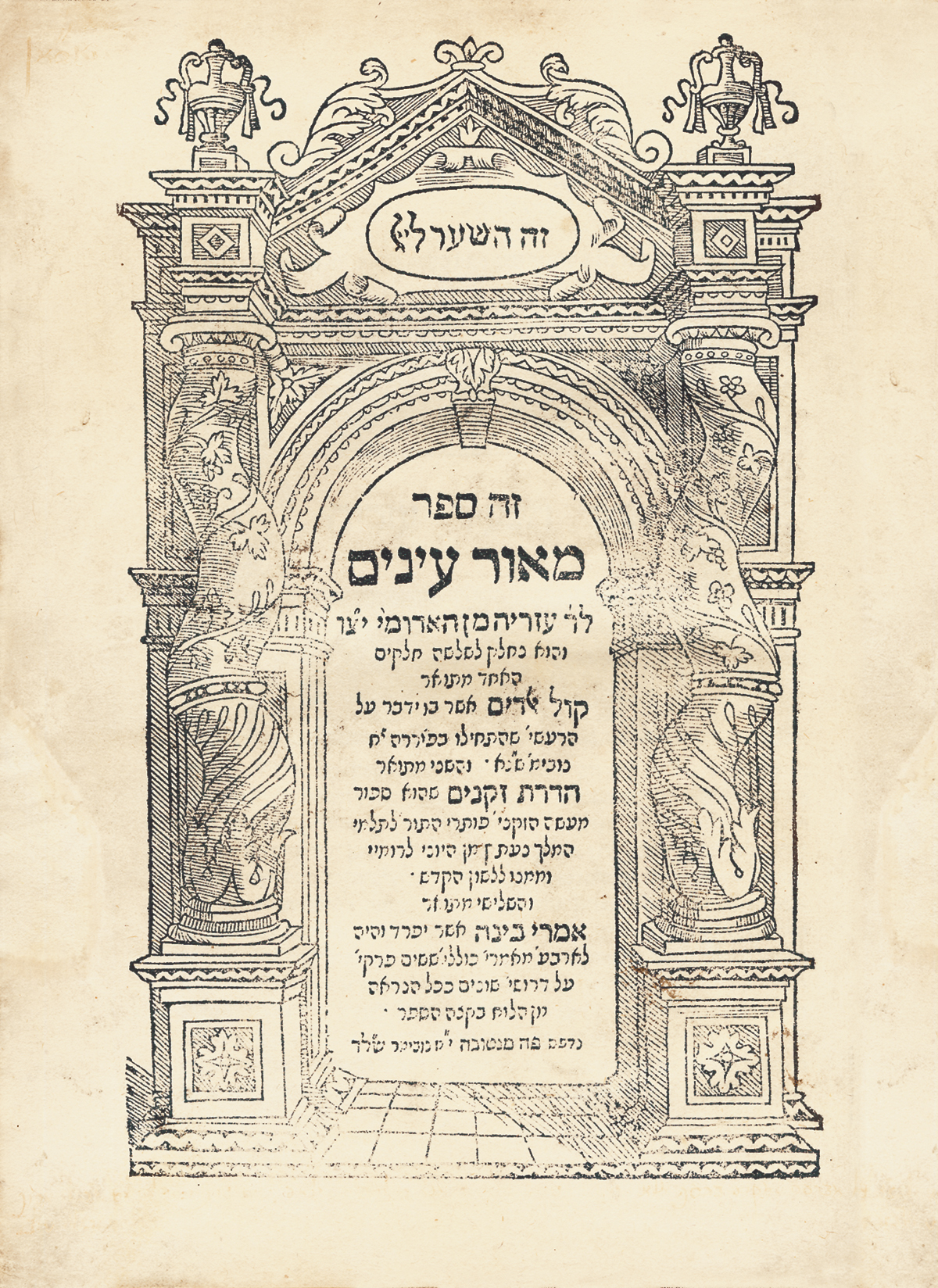
Auction 34 · Lot 45
Me’or Einayim [“Light of the Eyes”: historical studies]
- Estimate
- $2,000–$3,000
- Hammer price
- $2,000
Historical auction record. Hammer prices exclude buyer’s premium and taxes.
author
DE ROSSI, AZARIAH
printer
n.p
Place
Mantua
Publication
1574
Description
First Edition. Title within woodcut architectural border. Woodcut diagrams of priestly mitre on f.156r. This copy with the corrected “mahaduroth” which are in most standard copies, though without the rare “Mahahaduroth Shniyoth” affixed to very few copies. Censor’s signature on final page. Wide-margns
references
Vinograd, Mantua 138; Mehlman 1327; not in Adams
summary
“Me’or Einaim rendered its author as one of the greatest, or perhaps the very greatest, of Jewish historians who flourished in the seventeen centuries between Josephus and Jost.” S. Baron, “Azariah de Rossi’s Attitude to Life” in: Studies in Memory of I. Abrahams, (1927), p.12.
Azariah de Rossi (c.1511-c.1578), was a member of an Italian Jewish family that traced its ancestry back to the time of Titus and the destruction of Jerusalem. His controversial Me’or Einayim questioned conventional medieval wisdom and introduced fundamental changes in chronology. De Rossi rehabilitated the works of the Alexandrian philosopher Philo, and made good use of the Apocrypha and Jewish-Hellenistic sources in his study of ancient Jewish history and texts. By the same token, he exposed the popular Hebrew work “Jossipon” as an early-medieval compilation based on the authentic works of Josephus Flavius, though with much falsification.
De Rossi offended rabbinic sensibilities when he suggested that Midrashic literature was employed as a stylistic device “to induce a good state of mind among readers,” and thus, should not be taken literally. Such statements led the Me’or Einayim to be viewed as heresy and it was banned by the rabbinic authorities upon publication. De Rossi reissued the work the same year, making changes to the offending passages and adding an apologetic postscript. However, some prominent rabbis decreed that youth below the age of twenty-five must not consult the book. De Rossi himself was spared chastisement due to the stature of his piety.
See M. Carmilly-Weinberger, pp.210-13; I. Mehlman, Genuzoth Sepharim (1976), pp.21-39
ff.188. Small portion of outer margin on title-page repaired, stained in places. Lines stricken by the Censor’s pen are now visible due to the fading of the Inquisitorial ink. Elegant modern blind-tooled morocco with corner florets, spine in compartments. 4to
Enquire about this lot