
Auction 28 · Lot 312
(Pinkas Shadar)
- Estimate
- $20,000–$30,000
- Hammer price
- $36,000
Historical auction record. Hammer prices exclude buyer’s premium and taxes.
author
AZULAI, CHAIM YOSEPH DAVID (CHID”A).
Place
Europe
Publication
1753 (and later, 1778)
Description
Manuscript on paper. In Hebrew in a variety of Ashkenazic and Sephardic cursive scripts; also Italian, Spanish and Portuguese. Contains over 150 signatures of Rabbis and communal leaders in 63 cities. Final paragraph in the hand of the Chid”a concerning administrative detail
references
A. Yaari, Sheluchei Eretz Yisrael (1977) pp.569-80; M. Benayahu, Chaim Yoseph David Azulai (1958) p.422
summary
*** ANTHONY THIS INTRO TO BE PLACED (INDENTED) PRIOR TO LOT 312
LOTS 312 - 314.
Shelucha de-Rachmana (“Shadar”) was the title given rabbinical emissaries who were sent on missions from the Holy Land into the lands of the Diaspora. These men were scholars of the highest repute and greatest dedication whose task it was to deepen ties, as well as collect funds needed to support the often impoverished Jews of Eretz Israel.
The most important record of the emissary’s mission was the Pinkas Shadar Ledger in which rabbis and leaders of the communities visited by the emissary recorded sums donated, noted pledges, reported on community efforts on behalf of the mission, hospitality granted, and offered praises and blessings for the Holy Land and its inhabitants.
Avraham Ya’ari writes of the tremendous importance of these missions in his voluminous Sheluchei Eretz Yisrael (Jerusalem, 1951). They are important not only as a historical record of the activities of the Sheluchim, but also inform us about the relationship of the Rabbis and communal leaders with the Sheluchim (emissaries). They simultaneously reflect the economic and social conditions existing in various Jewish communities in Western Europe and elsewhere. Yaari records the activities of several hundered emissaries active from the 16th century and on. From the outset of his work, Yaari bemoans the fact that the vast majority of Pinkas ledgers, which are the primary historical source-material for this history are no longer extant.
Over four-centuries of Shadar activity, only thirteen Pinkas manuscripts are known (Yaari, pp.16-19). The earliest, recording a mission to Syria in 1671, is described by Y. M. Toledano in Sarid u-Falit (Tel Aviv, 1945), Vol. I, pp. 29-52 (present whereabouts unknown). The second surviving Pinkas, presently in the JNUL, records a mission to Europe, undertaken by Chaim Joseph David Azulai (his second trip to Europe during the 1770s). The third Pinkas record is of a trip to Eastern Europe between 1782-88, and is known only from an account provided by Y. Badahav in Ki be-Yitshak (Jerusalem, 1928), pp. 7-11. All others date from the 19th century, with some only in fragments.
The Pinkasim offered here, are not previously known.
Provenance of the following three lots:
1. Chaim Joseph David Azulai
2. Dr. N. Progres, Leipzig
3. Prof. Aron Freimann, Frankfurt a/Main
4. Sotheby Parke Bernet, 11th May 1981, Lot 1
----------------------------------------------------------------------------------------------------------------
THE EARLIEST SURVIVING PINKAS-SHADAR RECORD OF A MISSION TO EUROPE.
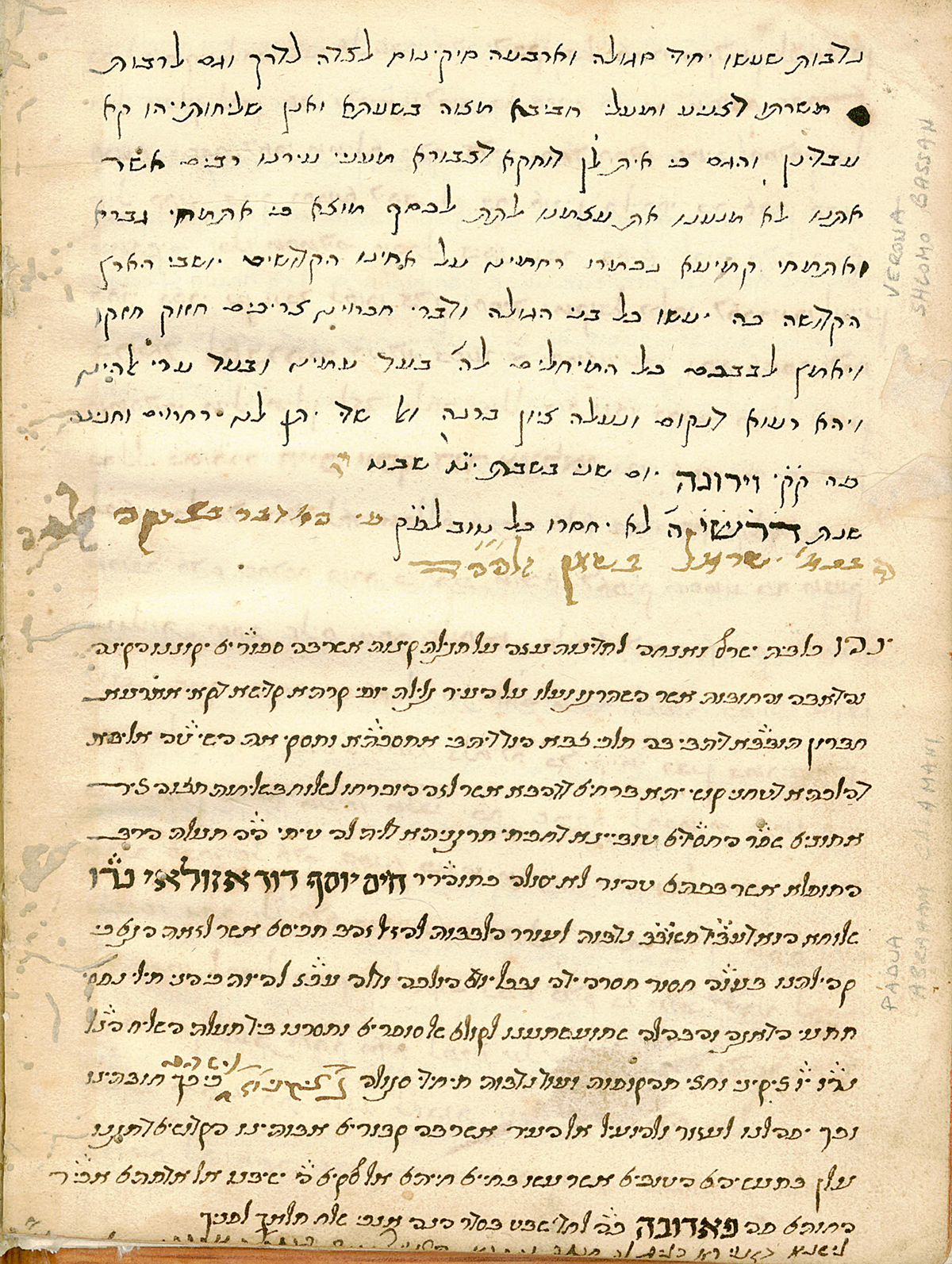
The original Pinkas Record of Chaim Joseph David Azulai (Chid”a) first mission to Europe from Hebron, between the years 1753 and 1758.
Azulai travelled to Italy, France, Germany, Holland and England. This Pinkas contains over 100 inscriptions from various communities, ranging from single paragraphs to several pages, along with some 150 signatures of rabbis and communal leaders. Noteworthy inscriptions of a page or more include: R. Yoseph Yuzpa Kosman (author of the definitive work on German Minhag); Yitzchak Lampronti (author of Pachad Yitzchak, the first comprehensive halachic encyclopedia); the prolific Halachist David Meldola; Shimshon Nachmani (author of Toldoth Shimshon) Simha Kalamani of Venice; Yisrael Bassan of Verona; and M.A. Matsliah of Florence.
Chaim Joseph David Azulai (Jerusalem, 1724-Livorno, 1807) was “one of the most prolific of rabbinic authors in the eighteenth century, and a pioneer writer on the history of rabbinical literature...(His) scholarship made him so famous that in 1755 he was chosen as meshullah (emissary), an honor bestowed on such men only as were, by their learning, well fitted to represent the Holy Land in Europe, where the people looked upon a Palestinian rabbi as a model of learning and piety” (JE vol. II, pp. 375-6).
The Chid"a also undertook a second European mission, commencing in 1772 that lasted several years. Included in the present manuscript are a number of leaves dating from 1778, while he was on this second mission, the remaining portion of this manuscript is found in the JNUL.
According to Meir Benayahu's biography of Azulai (Jerusalem, 1959), neither the hundreds of letters of recommendation that Azulai carried with him on his first mission, nor the Pinkas Shadar have survived (see p. 422)
The manuscript offered here is the “lost” Pinkas Shadar, and is THE EARLIEST KNOWN PINKAS SHADAR OF A MISSION TO EUROPEShelucha de-Rachmana (“Shadar”) was the title given rabbinical emissaries who were sent on missions from the Holy Land into the lands of the Diaspora. These men were scholars of the highest repute and greatest dedication whose task it was to deepen ties, as well as collect funds needed to support the often impoverished Jews of Eretz Israel.
The most important record of the emissary’s mission was the Pinkas Shadar Ledger in which rabbis and leaders of the communities visited by the emissary recorded sums donated, noted pledges, reported on community efforts on behalf of the mission, hospitality granted, and offered praises and blessings for the Holy Land and its inhabitants.
ff. 33 leaves. Some marginal worming, mostly repaired. Modern blind-tooled antiqued calf, with linen ties. 4to
Enquire about this lot