
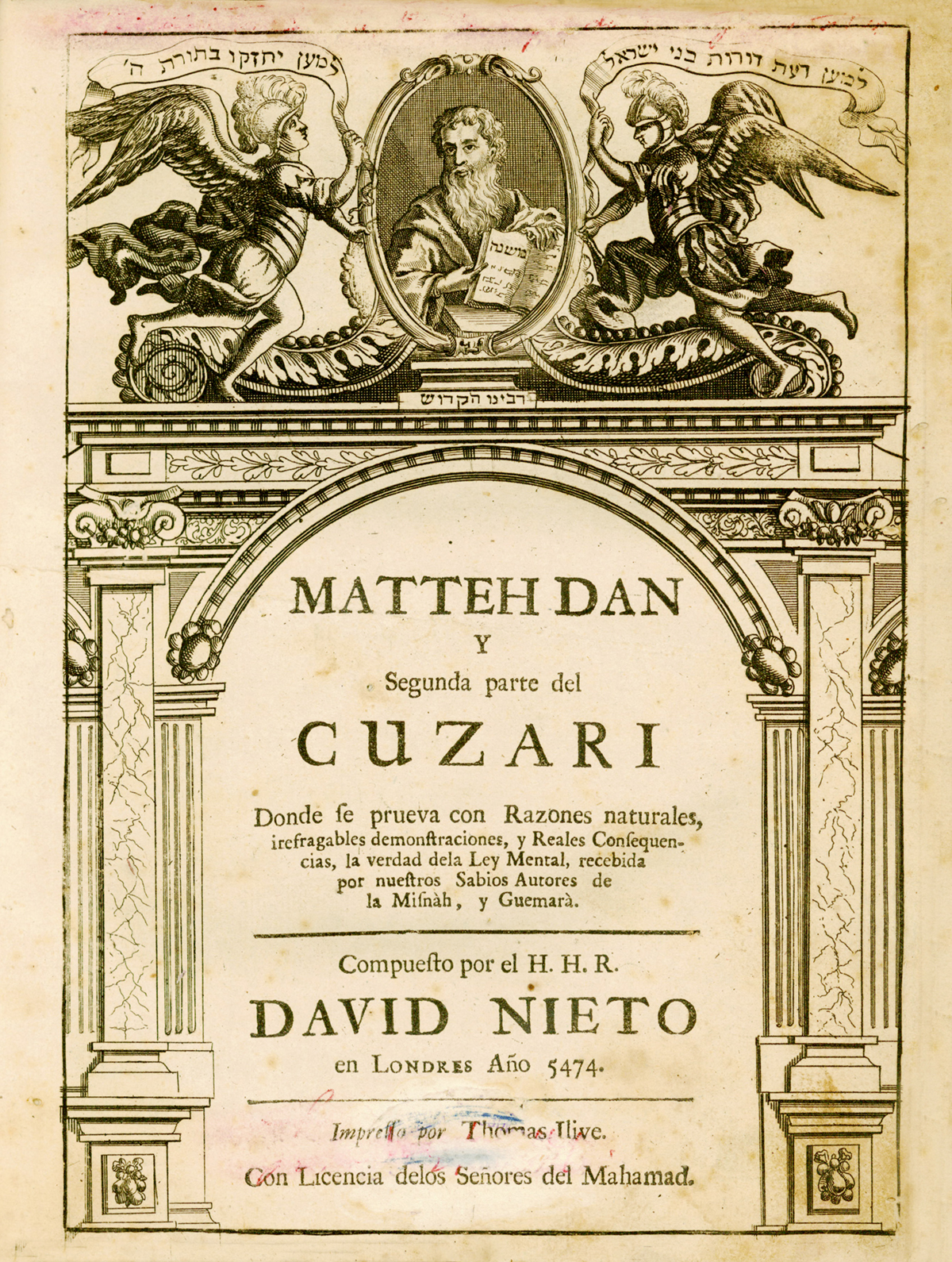
Auction 28 · Lot 252
Mateh Dan-Cuzari Chelek Sheni
- Estimate
- $1,500–$2,000
- Hammer price
- Not recorded
Historical auction record. Hammer prices exclude buyer’s premium and taxes.
author
NIETO, DAVID
printer
Thomas Ilive
Place
London
Publication
1714
Description
First Spanish edition. Decorated title, architectural arch incorporating portrait-roundel of Judah the Prince flanked by armour-suited angels. Printed in two columns
references
Roth, London 5; Kayserling 77
summary
HAHAM NIETO’S MAGNUM OPUS. THIS, THE PARTICULARLY SCARCE SPANISH ONLY ISSUE (Solomons traced only three complete copies extant).
Haham of the Spanish & Portuguese Synagogue in London, David Nieto (1654-1728) composed the Mateh Dan as a defence of rabbinic Judaism from the scorn of free-thinking former Marranos. Nieto considered his work a continuation of the tradition of Judah Halevi’s Kuzari (Fano,1506) a philosophical exposition of Judaism, opposing the attacks of Karaites, heretics and other creeds.
For a Census of the Spanish issue of the Mateh Dan, see Israel Solomons, David Nieto and Some of His Contemporaries, in JHSET, Vol. XII (1931) pp.26-7
USE PORTIONS ABOUT NIETO FOR FUTURE??
Defense of Judaism by Haham David Nieto with Important Note by Isaac Leeser.
Today, it is common knowledge that “Carlos Vero” is the pseudonym of David Nieto (1654-1728), Haham of the Spanish-Portuguese community of London between the years 1701-1728. True to the tradition of his native Italy, Nieto was what might call a “Renaissance man” in terms of his erudition and breadth of scope. He studied medicine at the University of Padua and was a linguist and astronomer of note. A seasoned polemicist, Nieto's magnum opus Mateh Dan or Kuzari Sheni (1714) is a defense of the validity of the Oral Law against ex-Marrano sceptics. A year later the Haham published Esh Dath, an attack upon Sabbatian heresiarch Nechemiah Chiya Chayon. Nieto's Reply to the Archbishop of Cranganor, in which he refutes the christological reading of the Bible, first appeared posthumously in the Spanish language (Villa-Franca, i.e. London, 1729). It was not until 1845 that Moses Mocatta produced in London an English translation. See JE, Vol. IX, pp. 302-3; EJ, Vol. XII, cols. 1152-3.
What is truly unique about our American edition of the work is the prefatory “Note” by Rev. Isaac Leeser of Philadelphia (1806-1868), staunch defender of Orthodox Judaism: “We would observe that Mr. M[ocatta] belonged to the British Jews' congregation who do not regard rabbinical authority as binding. Hence his allusion in the Preface which is not very complimentary to our old teachers.” See L.J. Sussman, Isaac Leeser and the Making of American Judaism(1995), pp. 209-210
ff. (6),272. Stamp from title removed, small portion of lower margin on final leaf removed. Contemporary half-vellu, worn. 4to
Enquire about this lot