
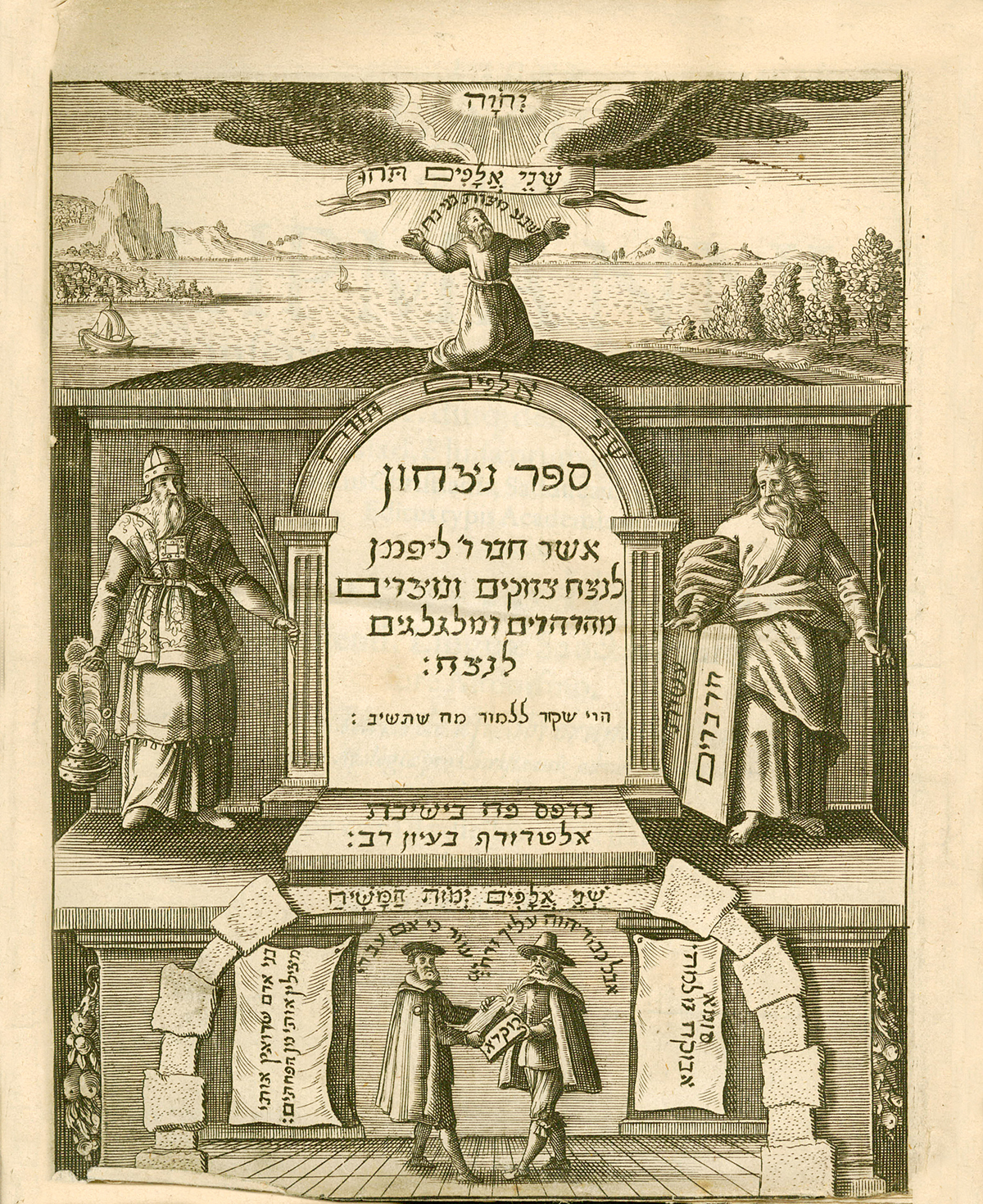
Auction 28 · Lot 244
Sepher Nitzachon-Liber Nizachon
- Estimate
- $1,200–$1,800
- Hammer price
- $1,600
Historical auction record. Hammer prices exclude buyer’s premium and taxes.
author
MUELHAUSEN, YOM-TOV LIPMANN
printer
W. Endter
Place
Altdorf-Nürnberg
Publication
1644
Description
FIRST EDITION. Edited by Theodor Hackspan. Engraved Hebrew title with additional Latin letterpress title. Hebrew text followed by Latin translation. Headpieces, tailpieces and historiated initials. Includes Teshuvoth Rada”k la-Notzrim [Responses of R. David Kimchi to the Christians] (pp. 196-200)
references
Vinograd, Altdorf 1; J.Rosenthal, Anti-Christian Polemics from its Beginnings to the End of the 18th Century, Aresheth II, p.148, no. 70; pp. 150-1 (facsimiles of Hebrew and Latin titles)
summary
An important polemic. A defense of Rabbinic Judaism and an attack upon Christianity and Karaism.
Yom-Tov Lipmann Muelhausen was one of the great rabbis of Prague, who began his activities as a polemicist early in life. His best-known disputation was with the apostate Peter in connection to the edict of apostasy issued against the Jews of Prague in 1389.
The intent of Muelhausen’s Sepher Nitzachon, composed in 1390, was to serve as a handbook for the ordinary Jew compelled at times to wrestle with complex theological problems. Written in a rationalistic vein, it sets forth a systematic debate against Christianity, following the biblical order in the presentation of its arguments. Muelhausen refutes the Christian interpretation of the Bible and the doctrines derived from them, and in so doing, incidentally provides many exegetic insights. His method is to expose the Christian lack of understanding of Hebrew sources with their linguistic and contextual associations and to ridicule aspects of the Christian religion. Muelhausen’s great superiority over other polemicists was his fluency in Latin and an intimate knowledge of Christian literature including the Evangelion, the Vulgate, the leading Church Fathers, as well as the works of the late Christian scholars.
Sepher Nitzachon was much copied in manuscript, but was first published by a Christian, the priest Theodore Hackspan, who strove to edit it with maximum faithfulness to the source, with the aim of enabling Christian scholars to oppose it. However, neither he nor the workers at his press had a full understanding of the language of the sources or of their subject matter, and as a result, this edition is full of errors.
Yom Tov Lipmann’s activities as a polemicist gave him lasting renown. Over the years a complete and ramified body of literature in refutation of him was produced, known by the general name of “Anti-Lipmanniana.”
See J. Rosenthal, Anti-Christian Polemics from Its Beginnings to the End of the 18th Century, Areshet II, pp.142-146; Carmilly-Weinberger, pp.186-87; EJ XI, cols. 499-502.
R. Yom-Tov Lipmann Muelhausen's Sepher Nitzachon is not to be confused with the older Sepher Nitzachon which it is assumed was composed in Germany in the latter part of the thirteenth century. The Nitzachon Vetus (Old Nitzachon), as it has come to be known in the scholarly literature, was first published by Wagenseil as part of his Tela Ignea Satanae (Altdorf, 1681). The Jewish Publication Society of America published a critical edition and English translation of the anonymous Nitzachon Vetus by Prof. David Berger (Philadelphia, 1979)
pp.16, 512, 24. Title page detached. Later boards, loose. 4to
Enquire about this lot