
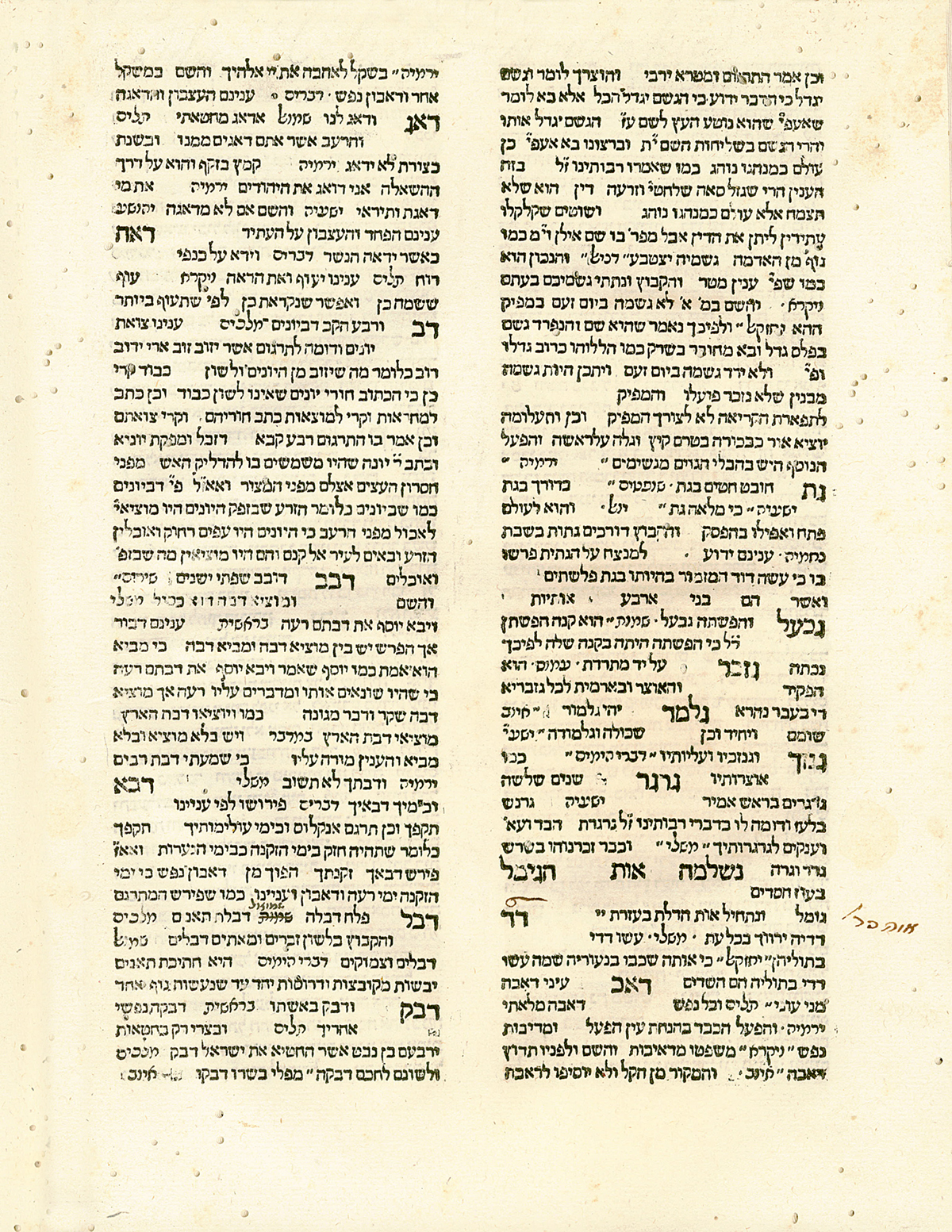
Auction 28 · Lot 196
(RaDa”K). Sepher Ha’sharashim [“Book of Roots;” a Biblical lexicon and grammar]
- Estimate
- $10,000–$15,000
- Hammer price
- $10,000
Historical auction record. Hammer prices exclude buyer’s premium and taxes.
author
KIMCHI, DAVID BEN JOSEPH
printer
Joshua Solomon Soncino
Place
Naples
Publication
1491
Description
Printed in two columns. Some marginalia in Hebrew and Latin
references
Vinograd, Naples 19; Offenberg 106; Goff Heb-40; Freimann-Marx, Thesaurus A-69
summary
THE MOST INFLUENTIAL LEXICOGRAPHICAL WORK FOR THE STUDY OF HEBREW
The formation of Hebrew grammatical rules was essential to facilitate the study and understanding of the Bible. The foundation of Hebrew grammar and lexicography were laid by Sa’adiah Gaon in the 10th century. This codification resulted in a revival of Hebrew as a literary language. A century later, David Kimchi’s purpose in composing the Sharashim, the second section of his philological treatise the Michlol, was “to provide a middle ground between the lengthy and detailed treatises of Jonah ibn Jonach and Judah ben David Chayyuj, and the extreme brevity and concision of Abraham ibn Ezra.” Kimchi’s chief contribution to Hebrew grammar lies in the popularization of such innovations as the division of vowels into five long and five short, the treatment of the Nifal as the passive of the Kal, and the distinction of the Vav Consecutive from the Vav Conjunctive. The notability of the Sharashim resulted in the works of his predecessors to fall into oblivion. See EJ, X col. 1002.
According to Joshua Bloch, this work with it’s “very rich collection of lexicographic material...increased the knowledge of the Hebrew language. This he accomplished with...numerous new etymologies as well as...new comparisons with post-biblical Hebrew...” Its popularity is evident from the fact that two editions appeared in Naples within a period of five months.
It has been noted (see G.Cohen, Hebrew Incunabula in the Library of Yeshiva University (1984) p. 87) that this edition is not censored. The previous 1490 edition has blank spaces for words referring to Christians, while this present 1491 edition explicitly uses the word “Notzrim” and other references
ff.164 (of 168), lacking opening leaf and final 3 leaves. Wormed (mostly marginal). Modern boards. Folio
Enquire about this lot