
Auction 24 · Lot 266
A.G.S. [Unidentified author. Disputation against Christianity]. An untitled, unpublished manuscript.
- Estimate
- $15,000–$20,000
- Hammer price
- $42,000
Historical auction record. Hammer prices exclude buyer’s premium and taxes.
author
(SEPHARDICA).
Place
n.p.
Publication
1700-1725
Description
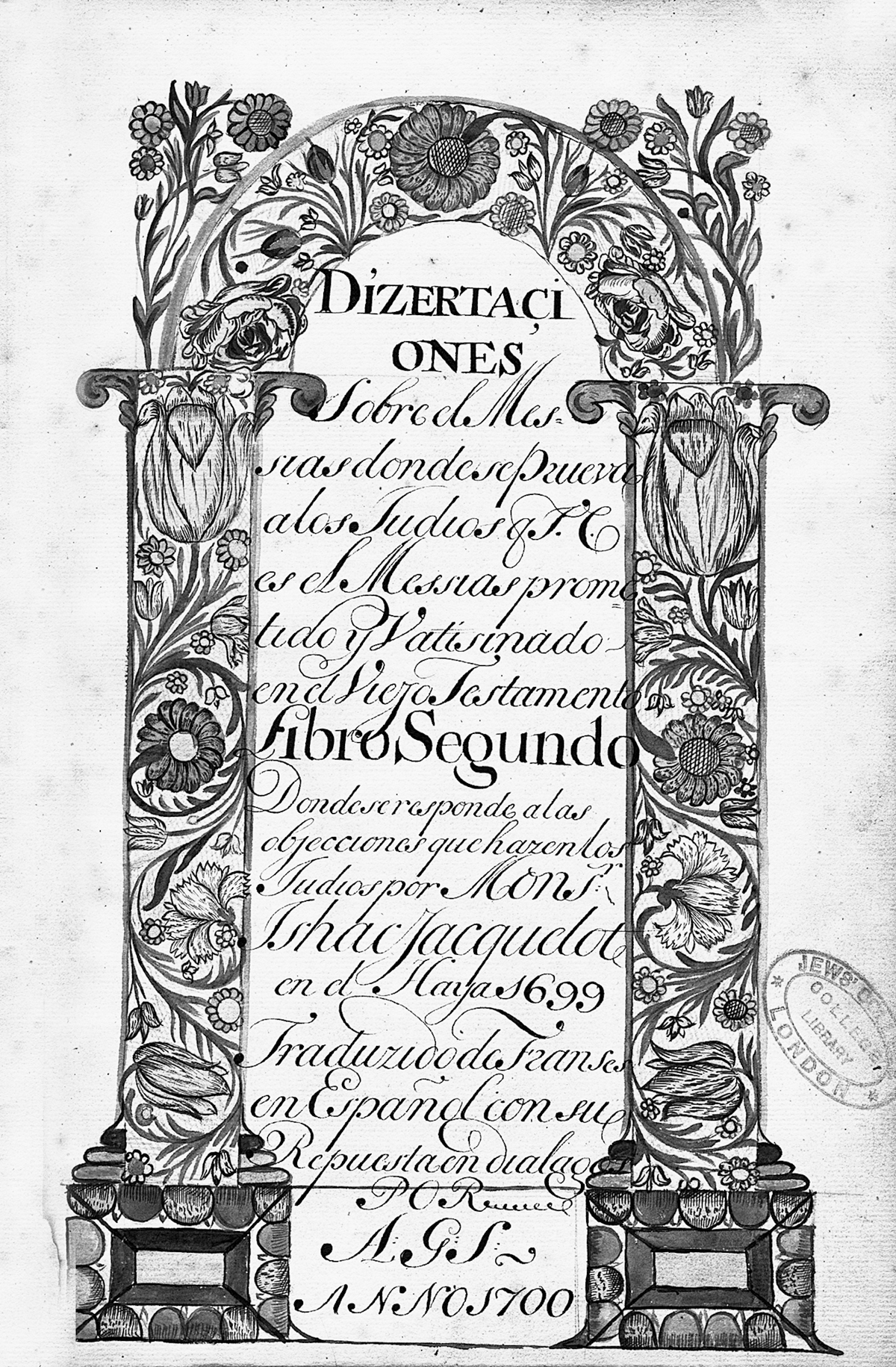
Six volumes. Spanish with an occasional Hebrew word. Text remarkably free of erasures or corrections. Title within architectural columns, beautifully wreathed and garlanded in vivid hues.
summary
A MONUMENTAL UNPUBLISHED WORK BY A MARRANO AUTHOR FROM THE LIBRARY OF THE JEWS’ COLLEGE, LONDON.
The identity of the author, who signs himself “A.G.S.” is unknown. On the title of Book I there occurs a dedication, “Por Mori Raby Behema, za”l” (For my teacher Rabbi Behema, of blessed memory). It is thought the author remained anonymous for fear of persecution. The writing of the manuscript continued for a protracted period of 25 years.
Our author sets out to systematically dismantle, point by point, Isaac Jacquelot’s French work, A Dissertation to Prove to the Jews that Jesus is the Messiah as Promised in the Scriptures (Hague, 1699). In so doing, he demonstrates ample knowledge of Bible and rabbinic literature from the sources (a favorite is Don Isaac Abrabanel), as well as thorough familiarity with classic Greek and Latin authors, and of course, the New Testament.
Grateful thanks to RABBI ARIE CYMET, LAKEWOOD, New Jersey, for his assistance in researching this manuscript.
A further six-page detailed examination of this manuscript available upon request.
THIS SHOULD HAVE BEEN ADDED BUT WAS’NT (SAVED FOR FUTURE REF)…
REPORT ON THE AGS MANUSCRIPT.
FOR KESTENBAUM & COMPANY.
Rabbi Arie Cymet.
I was not able to decipher the identity of the author in the manuscript. In the introduction, the author tells a little about himself, although he keeps his identity hidden by revealing only his initials, AGS, most probably not to endanger himself with the Inquisition. In volume 1, he is referred to as “Mori V’Rabi AGS.” He earned his livelihood writing books. The author mentions that he wrote a book, Arbol de las Ciencias, the equivalent of Eitz Hadaath in Hebrew, not to be confused with the book written by the Spanish philosopher Raymundo Lulio. He also relates that he does not intend to print the manuscript, but that he is writing it only for the benefit of several individuals close to him. This manuscript is, therefore most probably, the only copy that exists.
The author was very well versed in Tanach and Torah She Baal Peh, as well as in the Jewish philosophical literature. As such ex-marranos like Rav Menashe Ben Israel who lived in Portugal and Spain before returning openly to Judaism in Italy or Amsterdam, our author was well acquainted with the New Testament and Christian theology. From references on Volume 5 page 27 and from his poem on page 242, the reader is left with a strong suspicion that the author lived either in London, Amsterdam, or both, and most probably also in Italy, which was the usual route of most marranos. Some of his books, which were printed in Italy, ended up in the Port of Cadiz in Spain and were burned by the Inquisition. It is worthwhile to remember that Cadiz was the route by which the marranos tried to send literature to their brethren in the New World.
The manuscript, which consists of six volumes, was written during an extended period of 25 years between 1699 and 1724. The treatise is a polemic written from the Jewish standpoint against Isaac Jacquelot’s book A Dissertation to Prove to the Jews that J- is the Messiah Promised In the Scriptures. Isaac Jacquelot, was a prominent French Protestant Reform theologian, who was born in Vassy, France in 1647 and died in Berlin, Germany in 1708. Jacquelot’s book was written originally in French and also translated into Spanish. Among Jacquelot’s other works is a response against Baruch Spinoza’s theories. J. D. Eisenstein, in his Otzar Havikuchim does not mention our manuscript, although he covers many disputes, which were not printed and remained in manuscript form in libraries around the world. Eisenstein admits that he did not see all of them and that even among those works he did see, some were not noteworthy.
The first volume referred to by the author as Ante-Primero (Preamble) is a general introduction, which contains a set of rules upon which the debate is supposed to be based. The introductory volume is divided into three essays. The first essay deals with the necessity of religion. The second essay, which he refers to as Chapter One, discusses the history of the Office of the Inquisition and the power of the Church. The author’s view is that in a climate of punishment and terror, the truth cannot exist nor can be found. Only when the atmosphere is one of open-mindedness and reason can truth be reached. The third essay, which he refers to as Chapter Two, is a refutation of St. Agustin, whose thinking was that even by way of terror and violence when necessary, Christianity should be imposed. He quotes Agustin and refutes his every idea. At the beginning of each chapter is a heading, which tells what the debate to follow centers around. At the end of Volume Two, there is also an index.
The first two volumes of this manuscript are written in debate format, what is known in Hebrew literature as Viykuach. A.G.S. proves that the Scriptures can only be properly understood by the tradition of our sages and with the thorough knowledge of basic Hebrew. All the alleged proofs that Jacquelot brings stem from mistranslations of the Hebrew text. A.G.S. quotes freely from our early sages through the Rambam and Abarbanel and his contemporary Jewish philosophers. For example, in Volume Ante Primero, he quotes Haham R. David Nieto, Rabbi of Amsterdam author of the Kuzari Sheini. He also delves into what the Christians call the New Testament in order to refute Jacquelot’s proofs and to show that in the New Testament itself, there is no proof that would convince any reasonable person that J- is the messiah. Seemingly following the Ramban he also points out that from the overall situation in the world at large (wars, lack of justice, etc), it is quite evident that the messiah has not yet come.
Volume Three was written in 1700. It begins with a letter from A.G.S. to Jacquelot summarizing the points covered in the first two volumes. The format is different from the previous two; each chapter begins with a question posed either by Jacquelot or A.G.S. himself. It is unclear if the questions were actually asked by Jacquelot or if, as it was customary in polemic works, they were contrived by A.G.S. He then continues with a lengthy answer from A.G.S. One example is a question about how to understand obscure and allegoric parts of the Scripture. He makes clear that what is meant in a literal sense cannot be confused with what is allegoric, which caused the Christians to discard many precepts of Scripture. What is allegoric can only be established through the interpretation of the Rabbis and with a basic understanding of the Hebrew language. He quotes Don Yzhak Abarbanel:
If we could, at our will, mix what is clear with the allegoric, even the commandments of G-d, we will annul, resulting in heresy.
He also quotes Rabbi Menashe Ben Israel:
In the obscure is not where the salvation of man lays, but in what is clear. The obscure can only be understood by what is clear.
He also quotes Christian theologians and Bible scholars themselves to show that they agreed with this principle. Orobio Del Castro, Antonio Dessumon, Thomas De Aquino, were among many others cited. Some questions are multi dimensional. In a question posed, he enquires whether the mitzvos include all mankind or are limited to the Jews; he then goes on to explore if the laws of Moses are perfect and if there can be another Covenant with G-d. Answering this question, he quotes the Rambam from Igeret Teiman that if a prophet could give us new laws, idolatry must follow. In his answer there is subtle humor also: He quotes the famous statement of Ben Bag-Bag that everything is in the Torah, and then adds that many years spent in the university of Salamanca could not lead one to the wisdom of this one statement. He quotes two famous Rabbis from around his time, Rabbi Saul Morteira, the Sephardic Rav and Rosh Yeshiva of Amsterdam, circa 1660 from his Tratado De La Verdad De La Lei De Moises (“Treaty of the Truth of the Laws of Moses”) and Rabbi Isaac Atias, another of the great Sephardic hahamim of Amsterdam, Hamburg, and Venice, circa 1622 from his Tesoro da Preceptos (Otzar Hamitzvot). He contrasts these quotes with the Christian beliefs, which also center around the idea that the laws cannot be changed. The questions continue, each one dealing with another aspect of the differences between Judaism and Christianity and emphasizing the supremacy of Judaism over Christianity.
In Volume Four, A.G.S. writes in essay format without any input from Jacquelot. He asks for a true judge to pass judgment. As only G-d can settle this dispute it is necessary to remember that the only communication we have from G-d is through His Scriptures. A.G.S seems confident that he has successfully proven that Judaism has the upper hand. He takes apart Christianity by discussing the polemic between the Roman Catholic Cardinal of Perron and the Protestant Rev. Pierre De Viviere. He then responds to a book by Fernán Ximenes de Aragon, which he shows is full of falsehoods against the Jews and misrepresents the position of our saintly Rabbis. He shows that even Christian scholars use the rules that the Rabbis set to study the Bible. He shows that when they do not use these rules, they commit grave mistakes. He quotes the Rambam, referring to him as Rabeinu Moshe from Egypt and his thirteen principles of faith, as well as the six principles of faith of Rabeinu Chisdai Crescas, in his Ohr Hashem, and the three principles of Rav Yoseph Albo in his Sefer Haikrim. These three philosophers had different viewpoints on the question of Principles of Faith; Christianity does not conform to any of them. He quotes the New Testament and is highly critical of its verses and that it does not specifically state the exact claim that J- made. He elaborates how G-d’s law is superior to any other science that exists. In Chapter Six, he again brings a polemic between two Christian theologians, a Roman Catholic Cardinal, Roberto Belamino and a French Protestant Minister, Charles Orilecount to prove their weakness. He ends the volume with a beautiful prose and a dialogue between a Jew, a Protestant and a Moslem Turk.
The last volume, Volume Five, (which is really the sixth volume if you include the prologue), is a summary of the arguments in the earlier volumes. The author reiterates that the manuscript is not for printing purposes. The title page begins with a parable of the small David throwing a stone at Goliath. The style is the same as the previous two with questions asked and lengthy answers offered. The questions are basically the same as in the previous two volumes but he directs the answers toward the Inquisition and its injustices. On page 7, he points out that what the inquisitors refer to as compassion is really cruel punishment. They fear the truth, so they protect their falsehoods by resorting to violence. On page 22, he brings actual cases from the Inquisition and points out all its devious ways; the evidence in the trials was flimsy, the witnesses were shady; the lawyers were also prosecutors; the judges were overzealous.
He discusses on page 27 two new books published at the time in England that caused uproar in the Christian world. In one book, the author, Thomas Wooeston (Woolston), brings proofs from the Books of Moses to validate Christianity. However, by doing so, he denies the miracles of J’ and makes the claim that these miracles are to be understood figuratively. The other book was by M. Serenusius, professor of Hebrew in Amsterdam. A.G.S. criticizes them and points out that all their proofs are based on the alteration of the texts. A.G.S. ends every chapter with a poem exalting Judaism over Christianity and castigating the inquisition. On page 56, the poem mocks the idea of the trinity and that G-d could incarnate in the form of man. On page 77, A.G.S. again quotes Rav Menashe Ben Israel, refuting an opinion of Tosafot because it deviates from the plain explanation of the Scripture. With our holy Rabbis this is true, how much more so with anyone who wishes to introduce new ideas. On page 113, he tells a story in poem form from the Abarbanel about a Rabbi who converted to Christianity for a woman’s love. The Rabbi is asked about the differences between Judaism and Christianity to which he replies in a most picturesque way, which can only be fully appreciated in Spanish:
Before I had a G-d which I could not see, but he saw me. Now I see Him but He does not see me. I also see His portrait but I cannot stand His sight.
On page 120, he quotes a polemic between Rav Yitzchak ben Avraham and Grotius. In the Otzar Havikuchim, by Eisenstein there are two references to Rav Yitzchak ben Avraham, one called Igeret Al Tihi Ka’avotecha, an answer to a convert Bugot ben Guron and one called Chizuk Emunah, by a Caraite author also named, Yitzchak ben Avraham, about the nature of miracles in religion and how religion legitimizes miracles but miracles cannot legitimize religion.
Introduction: ff. (1), 2-228, (11). Book I. ff. (1), 259, (1). Book II. ff. (1), 179. Book III. ff. (1), 245. Book IV. ff. (1), 164, (1). Book V. ff. (1), 250, (1). 42 lines per page. Brown ink on coarse paper. “Pro Patria” watermark on paper. Blind-tooled calf with regal cartouche in center, six bands on spine, a.e.g. Covers loose. Folio
Enquire about this lot