
Auction 24 · Lot 82
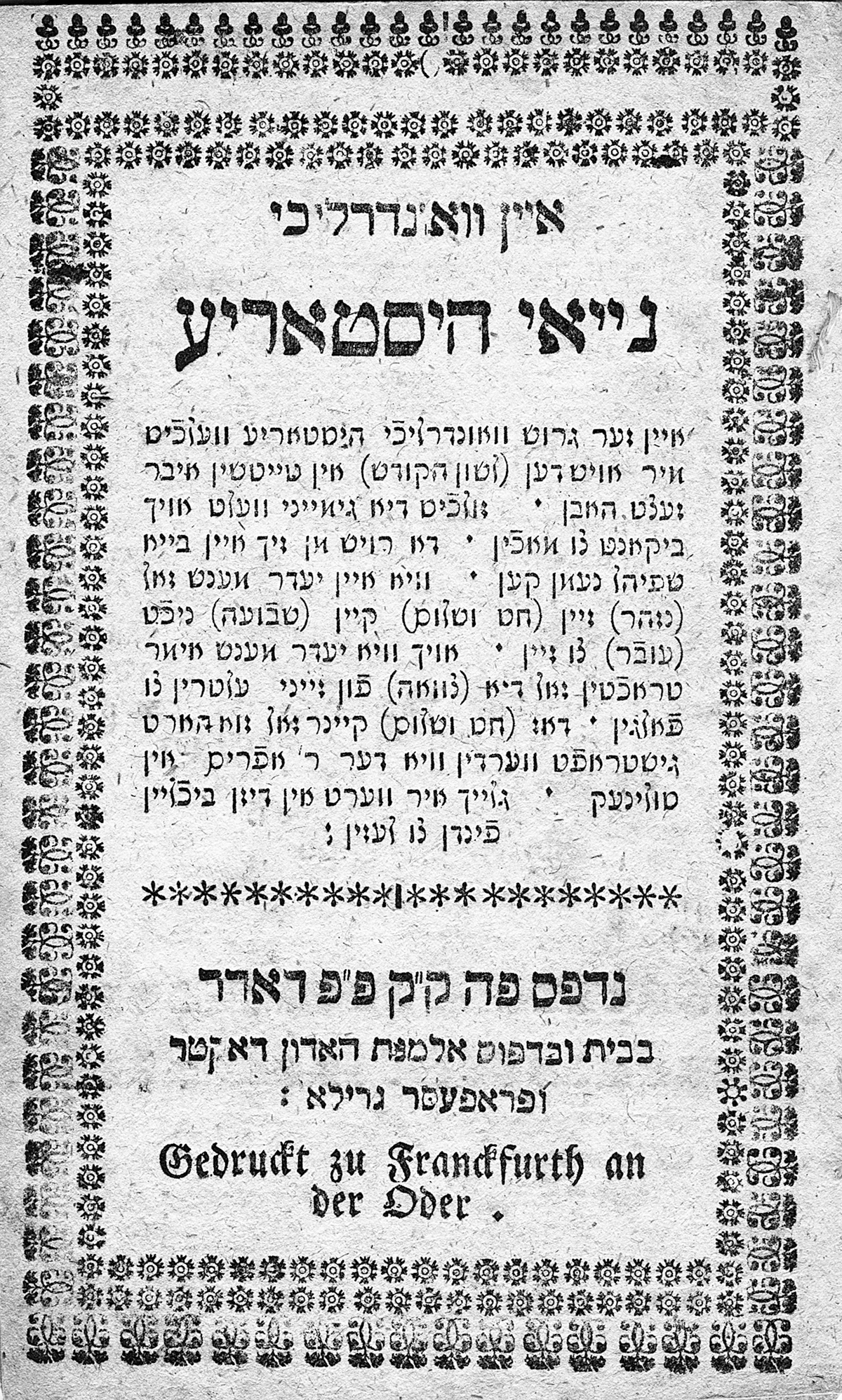
Eine Wunderliche Neie Historie [“A Wonderful New Story”]. Alternate title: Ma’aseh shel Yerushalmi [“Story of a Jerusalemite.”]
- Estimate
- $2,000–$3,000
- Hammer price
- Not recorded
Historical auction record. Hammer prices exclude buyer’s premium and taxes.
author
(FABLE)
printer
Widow of Doctor and Professor Grila
Place
Frankfurt on Oder
Publication
n.d. (late 18th century)
Description
Title within typographic border. Text in Judeo-German; wayber-taytsch type letter
references
Sarah Zfatman, Yiddish Narrative Prose (Jerusalem: Hebrew University, 1985), no. 179 (pp. 170-171)
summary
RARE YIDDISH FABLE-BOOK
Sarah Zfatman transcribes verbatim the beginning and end of the tale, but writes that the copy available to her was lacking the title-page, therefore, she was unable to determine the place of printing of the book, and incorrectly assumed that it was East European. With the title present in our copy, it is clear the place of printing was Frankfort on-Oder, althought the year of printing is not stated. Until 1767 the books in Frankfort on Oder were printed at the press of Prof. Grila. In that year, there appears the first book from the press of the Widow of Prof. Grila. Starting in 1792, Hebrew books in Frankfort on Oder are produced on the press of the “Daughter of Professor Grila.” Thus, our Yiddish fable was published between the years 1767-1792.
The story itself has all the makings of a spellbinding tale: Before his death, a wealthy Jew of Salonika (Turkey, today Greece), Salman ben Moshe, reveals to his son, Ephraim, the source of his fabulous wealth: dangerous voyages to distant lands, which on many occasions threated his life. The father insists his son take an oath that he will not engage in such perilous expeditions. As the reader can guess, the son does not keep his word, and eventually ends up marrying the daughter of Asmodeus, King of the Demons! The moral of the story is twofold: One should be careful not take a false oath, and also respect the last will of a dying parent.
Several scholarly studies have been devoted to the Ma’aseh Yerushalmi (Jerusalemite Tale). Ma’aseh Yerushalmi was first printed in Hebrew in Constantinople 1517, and again in Venice in 1544. See N. Aloni, “Bibliography of Ma’aseh Yerushami in Yiddish” in: Y.L. Zlotnick, Ma’aseh Yerushalmi (Jerusalem, 1947); S. Zfatman, nos. 86, 179
ff.16. Wrappers. 8vo
Enquire about this lot