
Auction 79 · Lot 161
Discorso intorno a l’humana miseria e sopr’al modo di fuggirla [“A Discourse on Human Suffering and How to Escape It”]. ff. (4), 38.
- Estimate
- $1,000–$1,500
- Hammer price
- Not recorded
Historical auction record. Hammer prices exclude buyer’s premium and taxes.
author
POMIS, DAVID DE
printer
Giordano Ziletti
Place
Venice
Publication
1572 and 1571
Description
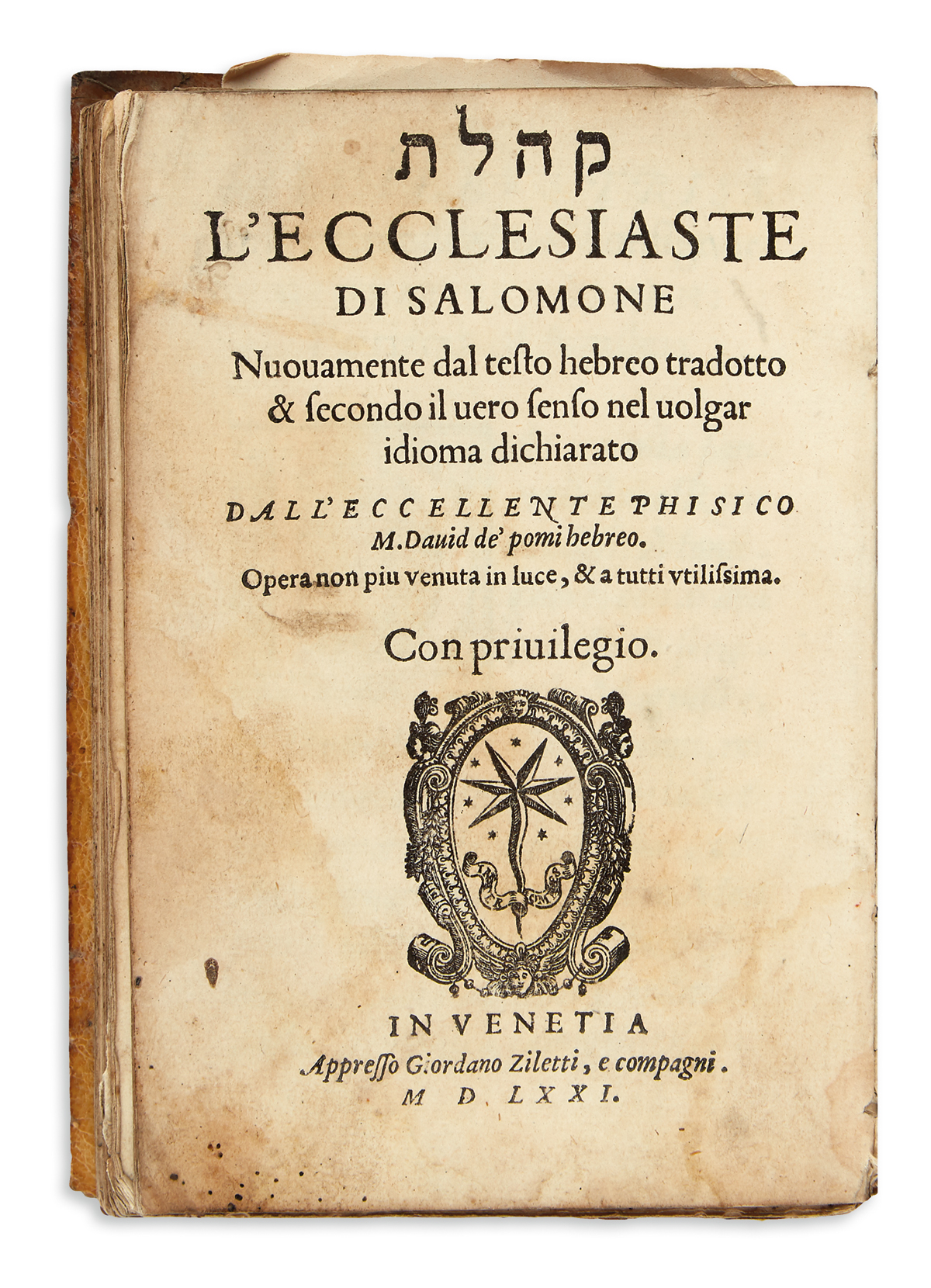
* BOUND WITH: Koheleth-L’Ecclesiaste di Salomone. Hebrew text with inter-linear traslation into Italian. With introduction and explanatory notes in Italian by David de Pomis. Dedicated to Cardinal G. Grimani. ff. (8), 41 (of 42), (2) lacking f.1. [Vinograd, Venice 572]. Two works bound into one volume. BOTH FIRST EDITION. Printer’s device on each title-page. The Daniel M. Friedenberg - Prof. Ariel Toaff copy (with respective bookplates).
summary
David ben Isaac de Pomis [min HaTapuchim] (1525-93) was a scion of one of the four most distinguished Roman families reputedly brought by Titus from Judea to Italy at the time of the destruction of the Second Temple. De Pomis was a practicing rabbi and physician who received his medical doctorate from the University of Perugia in 1551. Throughout his life, De Pomis’ ability to practice medicine was periodically restricted by Papal edicts that forbade Jewish physicians attending Christians. The subsequent lulls in his medical career gave him the opportunity to gain repute as a writer and linguist. He composed several medical pamphlets, a trilingual dictionary, as well as Italian translations of the Bible. The present two works are thus representative of the scope of de Pomis’s scholarship: A Biblical translation and an holistic medicinal discourse in which De Pomis shares the methods he had formulated to distract himself from misfortunes suffered. The second work was published as an appendix to the first, intended as a practical afterword to King Solomon’s treatment on temporal suffering.
See C. Roth, The Jews in the Renaissance, pp. 223-25.
Stained in places. Later vellum, worn. Sm. 8vo.
Enquire about this lot