
Auction 72 · Lot 179
(MEGILATH ESTHER).
- Estimate
- $3,000–$5,000
- Hammer price
- $2,500
Historical auction record. Hammer prices exclude buyer’s premium and taxes.
printer
The Brothers Proops
Place
(Amsterdam
Publication
Second half of the 18th-century)
Description
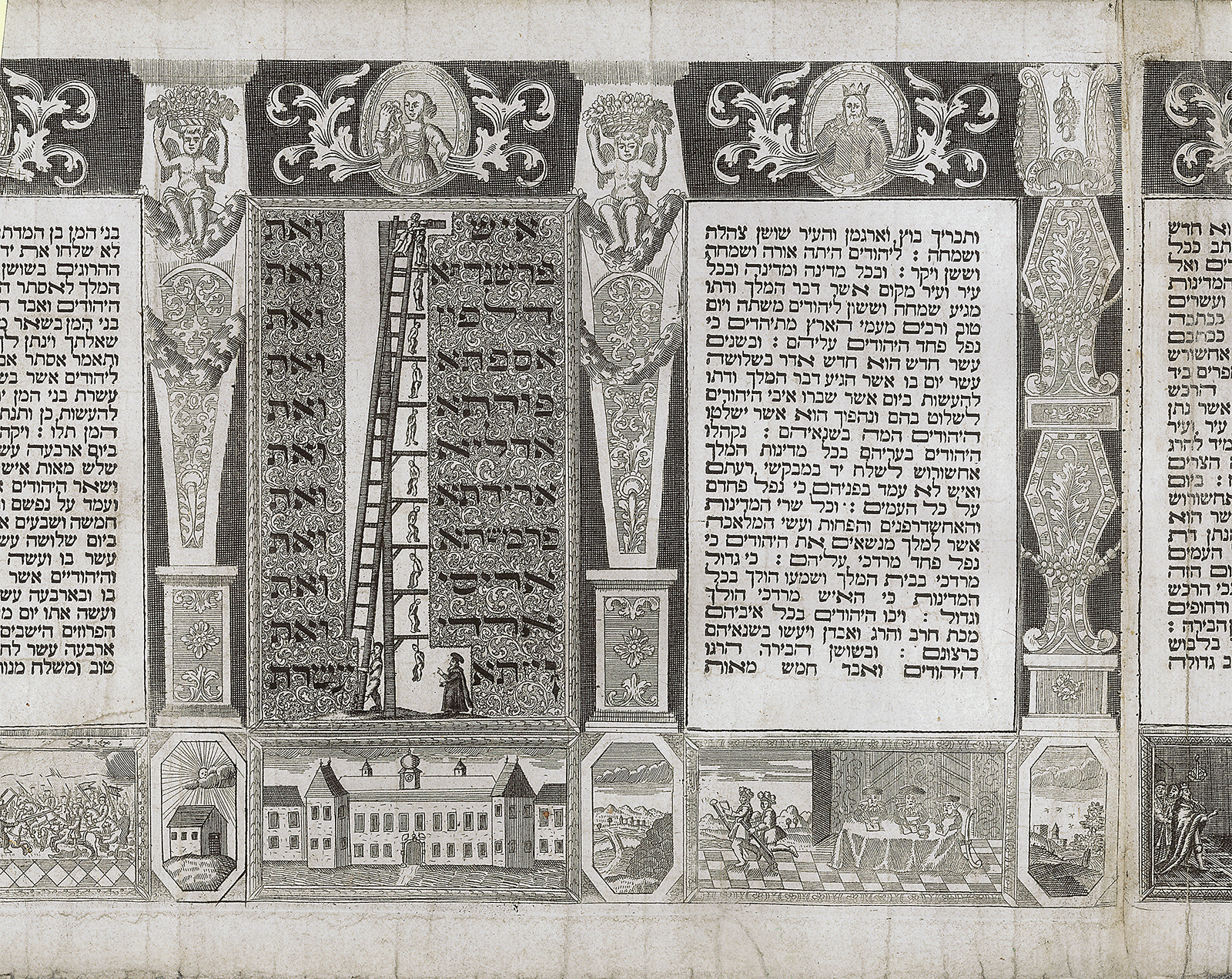
Complete Scroll of Esther on paper. Printed text within lavish engraved pictorial border. Five joined leaves, 22 text columns, plus an elaborately decorated opening panel containing initial blessings. First text panel with enframed, enlarged initial word; final panel containing blessing and prayers recited after the megillah reading, Hebrew square and semi-cursive printed types. The text set within elaborately engraved historiated borders depicting the characters and events that populate the Esther story, medallion vignette portraits above.
summary
This rare Megillah provides valuable insight into the origins of an important series of engraved Esther Scroll borders. Produced in the 18th century and extant in multiple copies and versions, these richly decorated borders long defied localization, and were variously attributed to Italy, Germany, Bohemia/Moravia, and the Netherlands. What distinguishes the present example from nearly every other representative of this type, is the fact that it was produced on paper (rather than parchment) and contains a printed (rather than handwritten) text. Though such a scroll is not considered valid for liturgical recitation, it was only through a close examination of the material and typography of an identical scroll, (sold at Christie’s, Amsterdam, 18th June 2002, lot 390), conducted by Dr. Adri K. Offenberg, that established beyond the shadow of a doubt that these exceptional Esther Scroll borders were printed in the city of Amsterdam in the second half of the 18th century.
Offenberg’s examination revealed that two large sheets of high quality Dutch Royal paper, cut horizontally and vertically, were used to construct the megillah. By identifying the watermarks, Offenberg was able to effectively narrow down the years in which the paper was produced to between 1730-1770. (The same watermarks identified by Offenberg in 2002 are also found on the present scroll.) Offenberg further posited that a likely candidate for the printers of the current scroll, were the Brothers Proops (Joseph, Jacob and Abraham Proops), who were active in Amsterdam between 1734 and 1773.
Paper repairs, affecting text of blessings, few minor marginal minor defects, occasional staining, creased as expected. Overall, a strong clear impression. H: 22.3 cm. L: 235 cm. H: 8.75 L: 92.5 inches.
Enquire about this lot