
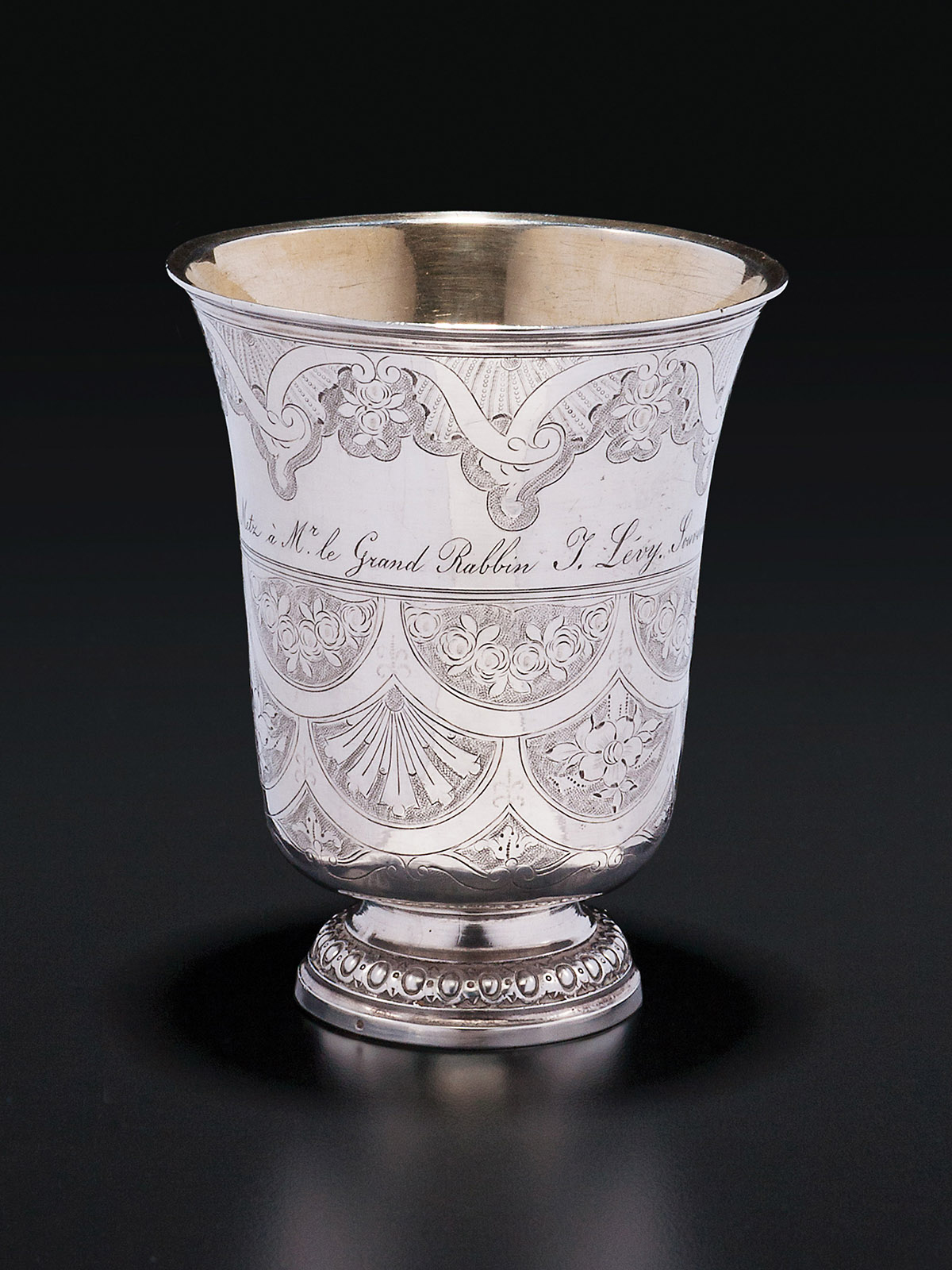
Auction 62 · Lot 296
IMPORTANT FRENCH SILVER-GILT KIDDUSH BEAKER.
- Estimate
- $10,000–$15,000
- Hammer price
- $9,500
Historical auction record. Hammer prices exclude buyer’s premium and taxes.
Description
Of classic form with flared lip, engraved below rim with swags of flowers on textured ground above panels of flowers and shells, gilt interior, on pedestal foot. Central band later inscribed: “La Communauté Israélite de Metz à Mr. le Grand Rabbin I. Levy. Souvenir de la Céremonie du 7, 7bre 1871.” Marked: Paris, 1773. Height: 4.5 inches.
summary
Following the end of the Franco-Prussian War, a solemn service commemorating fallen French soldiers was held at the Great Synagogue in the city of Metz. Due to Germany’s victory and subsequent annexation of the Alsace-Lorraine region, the local French Rabbinate was faced with important decisions in regard to national loyalty.
Grand Rabbi Isaac Levy of Colmar addressed the Metz community and according to Archives Israélites (October 15th, 1871), “a majority were wearing boutonnieres of flowers set on ribbons of the French national colors. The synagogue and holy ark was draped in black in mourning.” In appreciation of the Rabbi’s participation, the Jewish community of Metz presented him with the this silver goblet.
Born in the small Alsatian village of Marmoutier, Rabbi Isaac Levy (1835-1912), was appointed in 1869 as the Grand Rabbi of Colmar, in the Alsace-Lorraine region. He was one of the three Grand Rabbis of Alsace-Lorraine and was particularly noted for his intense French patriotism, having written popular allegorical works on the topic of the Jewish loyalty to France - including French occupied lands, following the loss of Alsace-Lorraine in the Franco-Prussian War. Indeed some 600 Jews moved into the French interior following the annexation by the German Empire of their newly acquired lands. “In 1871-72 Jewish sentiment about the annexation more closely resembled those of Catholics than those of Protestants…Two of Alsace-Lorraine’s three Grand Rabbis, Isaac Levy of Colmar and Benjamin Lipman of Metz, turned down Prussian offers to remain at their posts at double salary in order to opt for French citizenship.” (See V. Carron, Between France and Germany: The Jews of Alsace-Lorraine, 1871-1918, (Stanford University Press, 1988), p. 50). Rabbi Levy left his Alsace-Lorraine post and relocated to a new rabbinical position created for him by the Consistoire in Lille.
During this period in France and Germany it was fashionable among the upper-classes to collect old, quality silver. In keeping with this fashion and the importance of the synagogue service, this-then 98 year old cup was located, inscribed and gifted to Grand Rabbi Levy as a souvenir from the Jewish community of Metz, whose leader, Grand Rabbi Lipman, shared identical political views with Levy, as did the entire Metz community. “It is possible to confirm that in 1870 the Jews of Metz had become integrally French, in their life and their civilization and not only in law.” (V. Carron, Between France and Germany, p. 23).
An historic item of Judaica that sheds light on French-Jewish patriotism of this era. Of the utmost importance.