
Auction 55 · Lot 260
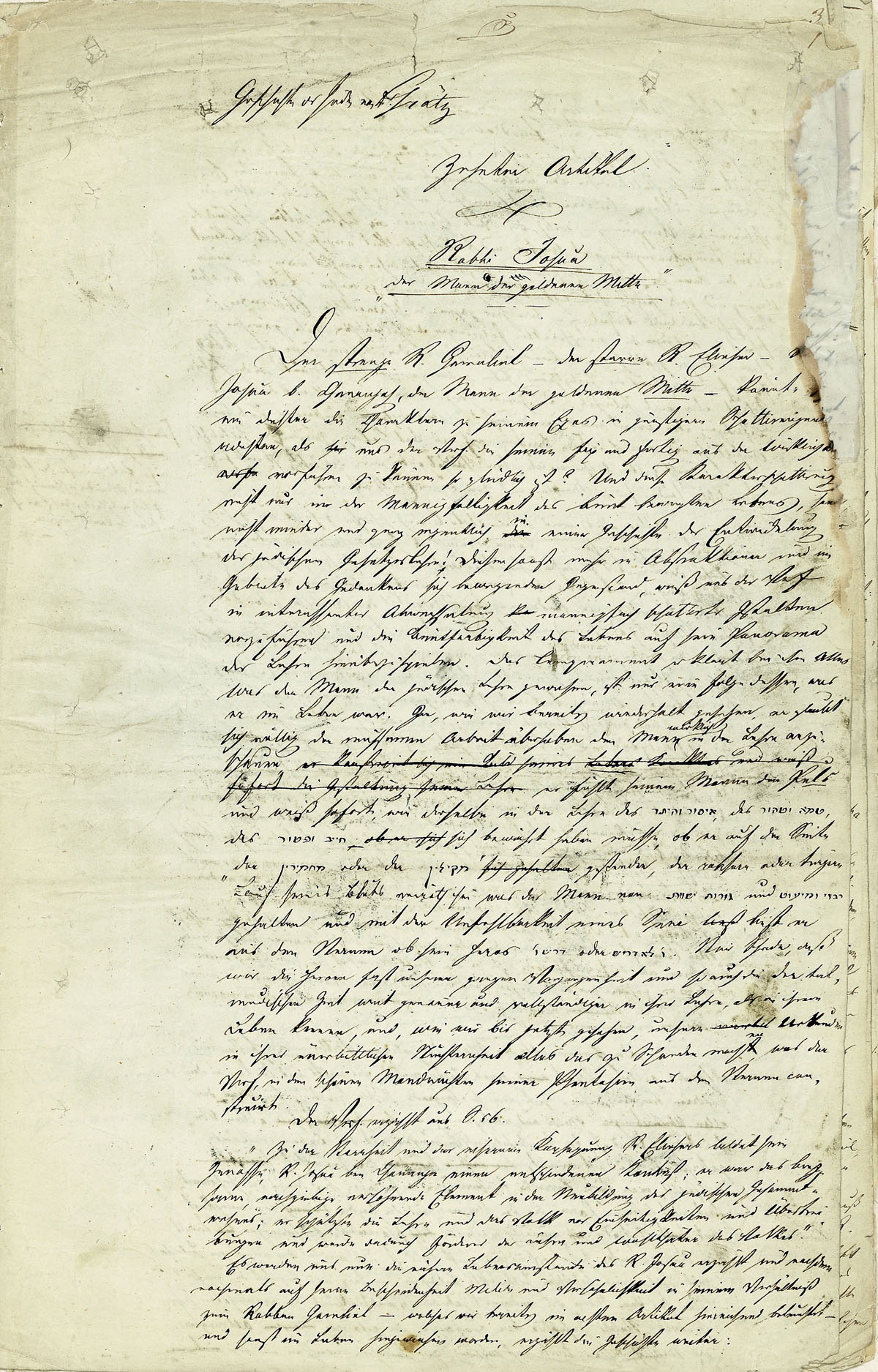
“Rabbi Josua: Der Mann der Goldene Mitte.” Autograph Manuscript in German, with occasional use of Hebrew.
- Estimate
- $5,000–$7,000
- Hammer price
- Not recorded
Historical auction record. Hammer prices exclude buyer’s premium and taxes.
author
HIRSCH, SAMSON RAPHAEL.
Place
Frankfurt a/Main
Publication
1857
Description
Brown ink on paper. pp.16.
summary
Sensational in its time, Samson Raphael Hirsch’s trenchant German-language defense of Jewish tradition, “Nineteen Letters on Judaism” was published in 1836, affecting no one more powerfully than the young rabbinical student Heinrich Graetz. However over a period of time, Graetz became increasingly sympathetic to Zacharias Frankel’s historical positivism - “historical” in its embrace of critical inquiry, “positivist” in its attachment to traditional observance. Meanwhile, employed as a schoolmaster, Graetz was working on his pioneering synthesis of Jewish history, which fused Hirschian idealism and academic freedom and published in four volumes in Berlin in 1853. In 1854, Frankel was appointed to head the new historical positivist Jewish Theological Seminary in Breslau, and Graetz accepted an invitation to join the faculty. This was regarded by Hirsch as an absolute betrayal, and the breach was solemnized in a series of twelve withering review articles, which Hirsch, now in Frankfurt, contributed to Jeschurun, the influential “monthly for the furtherance of Judaism and Jewish life” that he had founded there.
The present manuscript comprises the holographic copy of the tenth of these attacks, which takes the form of a critique of the third chapter of Graetz’s book, dedicated to a comparison of the preeminent rabbis of the second generation after the destruction of the Temple. The article appeared in Jeschurun vol 3 (1857) pp. 229-254. This is no fair copy, however, but the original version, full of alterations in the Hirsch’s hand. Invariably eloquent, frequently pugnacious, and the master of a style all his own, Hirsch proclaims here that the plain facts “demolish the pattern that the author has managed to construct out of the stars in the beautiful moonlit nights of his fantasies.” Fundamentally, Hirsch objects to Graetz’s presumptuousness in assigning what can anachronistically be called psychological motivations to his protagonists.
A manuscript poignant for the falling out of faithful friends and important because that falling out represents a clash of titans of modern Jewish thought.
Occasional tears in margins, with minimal loss of a very few letters on four pages only. Bound into modern calf boards. Folio.
Enquire about this lot