
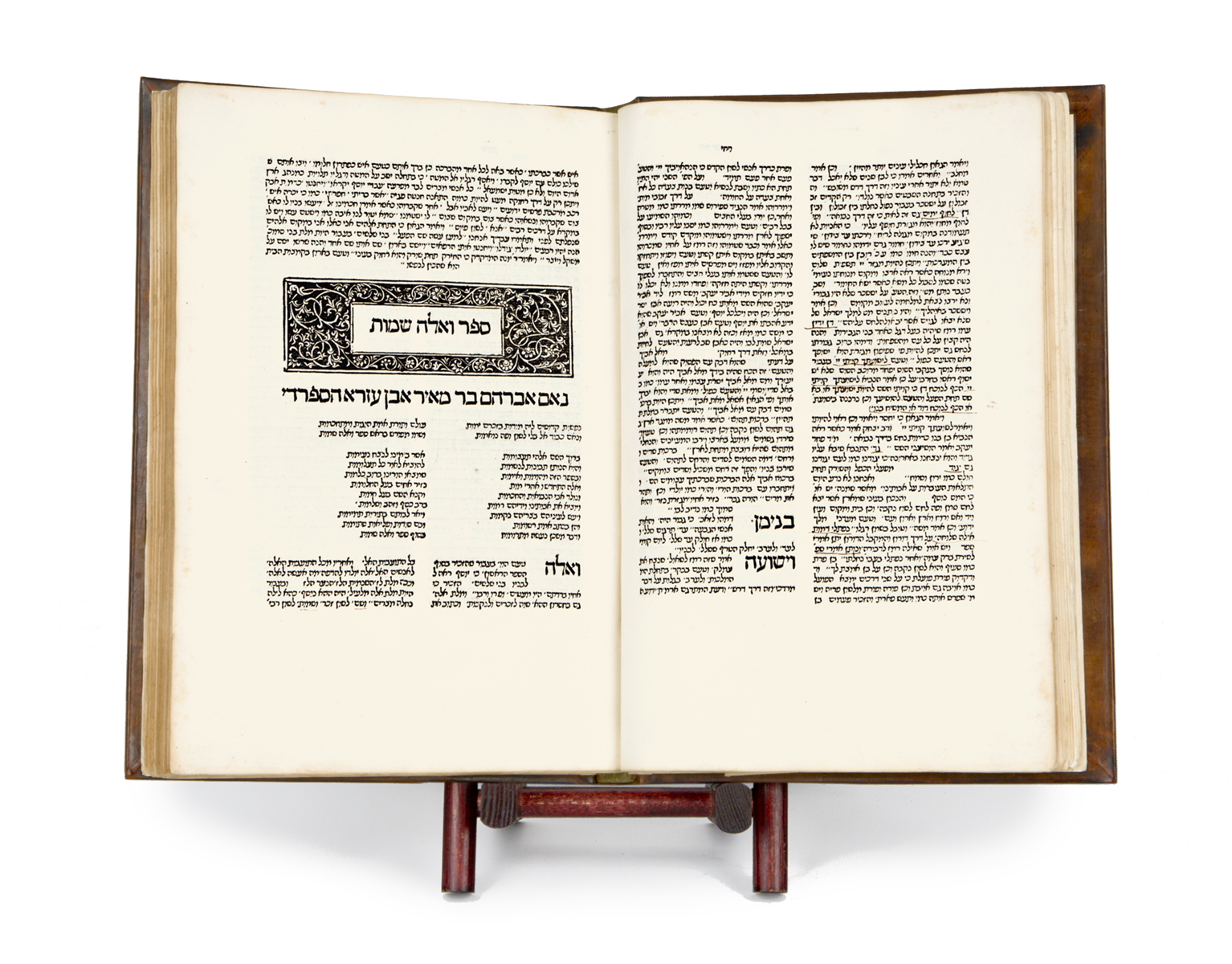
Auction 43 · Lot 38
Peirush ha-Torah [Commentary to the Pentateuch]
- Estimate
- $200,000–$300,000
- Hammer price
- $200,000
Historical auction record. Hammer prices exclude buyer’s premium and taxes.
author
ABRAHAM IBN EZRA.
printer
Joseph ben Jacob Aschkenazi Gunzenhauser & Son
Place
Naples
Publication
1488
Description
FIRST EDITION. First word of each book floriated. Headers in square characters, text in rabbinic script. Printed in double columns. The paper exhibits watermark of hand with shirt-cuff and fingers pointing to a star-shaped blossom. Wide margins. Some underlining and Latin marginalia in sepia ink. The Sassoon Copy.
Despite minimal faults noted below - AN ASTOUNDINGLY CLEAN AND WIDE-MARGINED COPY.
references
Vinograd, Naples 6; Goff 1; Goldstein 52; Offenberg 56; St. Cat. Bodl. p. 680, no. 4221-1; Thes. A60; Wineman Cat. 34. Not in Cambridge University
summary
THE INTERNAL CONDITION OF THIS INCUNABLE MAY COMFORTABLY BE STATED AS BEING ONE OF THE VERY FINEST TO HAVE APPEARED AT AUCTION FOR A GREAT MANY DECADES.
It would be difficult to find a medieval sage as peripatetic as Abraham ibn Ezra (1089-1164). A native of Tudela, Spain, he lived at different times in North Africa, Italy, France, and England. Despite the maverick nature of his commentary - which does not accept rabbinic tradition uncritically - the author was revered throughout the ages. Ibn Ezra belonged to a school of Spanish pashtanim, who sought - by heavy reliance on Hebrew grammar and Semitic linguistic analysis - to arrive at the simple meaning of the Bible. In this respect, they differed greatly from the French school of Rashi and the Tosaphists, whose commentaries are informed by the midrashim of Rabbinic lore, and even from later Spanish exegetes, such as Nachmanides, whose commentary makes ample use of the Kabbalah or Jewish mysticism. In his purism, or perhaps reductionism, Ibn Ezra came into contact with the Karaite commentators, such as Japheth ben Ali, et al, who rejected outright the Rabbinic tradition. Nonetheless, time and time again Ibn Ezra concludes a discussion by commenting to the effect "that we rely on our tradition." Thus, after all of his forays into the uncharted world of peshat, ultimately, Ibn Ezra remains faithful to traditional Halacha.
The Gunzenhausers, pioneers in Hebrew printing, arrived in Naples from Gunzenhausen in Southern Germany. In Naples they established a press, assembled a talented team of typsetters and proof-readers, and between the years 1487-1492 produced in sum twelve books. After the death of Joseph Gunzenhauser in 1490, the press continued under his wife and son Azriel.
From the Library of the late Rabbi Y. Stern, London.
ff. 98. Expert repairs to first three leaves, few miniscule stains. Finely bound by Joseph Gradenwitz, London - modern blind-tooled calf; spine in compartments. Folio
Enquire about this lot