
Auction 39 · Lot 219
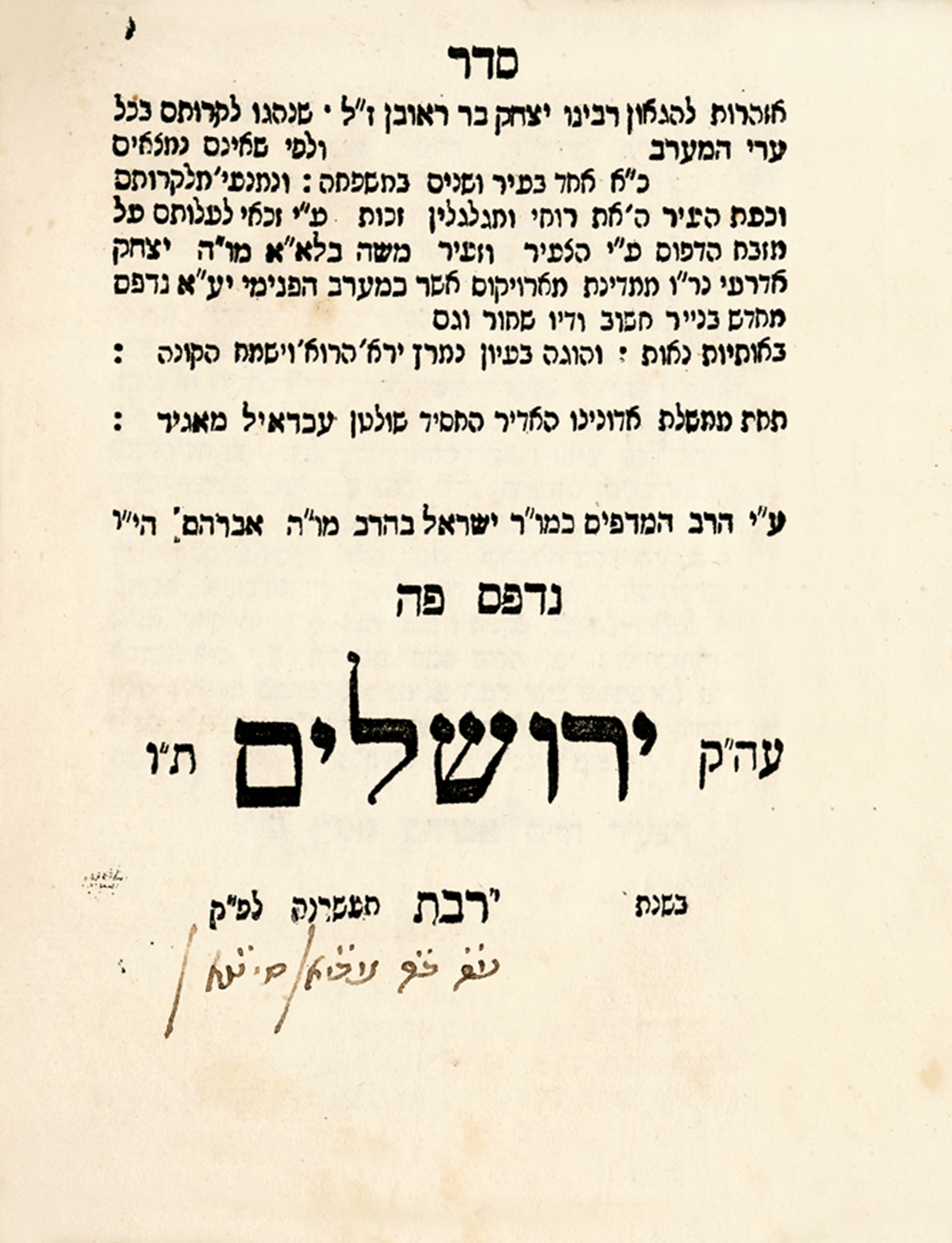
Al-Bargeloni, Isaac ben Reuben. Seder Azharoth [liturgical poetry for Shavu’oth]
- Estimate
- $1,500–$2,000
- Hammer price
- Not recorded
Historical auction record. Hammer prices exclude buyer’s premium and taxes.
author
(LITURGY)
printer
Israel ben Abraham [Bak]
Place
Jerusalem
Publication
1842
references
Vinograd, Jerusalem 10; Halevi 6
summary
Azharoth are poetic arrangements of the 613 commandments to be recited on Shavu’oth. Authorities who contributed to the Azharoth literature are: Sa’adyah Gaon, R. Elijah the Elder, R. Solomon ibn Gabirol, R. Isaac b. Mordecai Kimhi (Maestre Petit de Nions), et al. Various communities adopted azharoth of different medieval poets. The Azharoth of R. Isaac ben Reuben Al-Bargeloni (i.e., of Barcelona) were adopted by the communities of Morocco. Indeed the present edition was issued by the Moroccan Rabbi Moses Edrehi. It bears the haskamah (encomium) of Rabbi Hayyim Abraham Gaguine, the Rishon le-Zion or Chief Sephardic Rabbi of Eretz Israel.
The Spanish Talmudist and liturgical poet Isaac ben Reuben Al-Bargeloni (i.e., of Barcelona)(b.1043), a contemporary of R. Isaac Alfasi, served as dayan in the coastal city of Denia. Unfortunately, his commentaries to Talmudic tractates have not been preserved. The azharoth of Al-Bargeloni are noted for their skill; all 145 strophes ending with a biblical quotation. (See R. Chaim David Azulai, Shem ha-Gedolim II, s.v. Azharoth; JE, Vol. VI, p. 629; EJ, Vol. II, col. 525).
Publisher Moses Edrehi (c.1774-c.1842) was a most colorful character and in his introduction here, he recounts his personal narrative. A native of Agadir, he grew up in Essaouira (Mogador) and Rabat, where he studied under R. Judah Anhouri. Eventually, he settled in London, where he was ensconced in the Beth Midrash and soon married. Upon the death of his first wife, he removed himself to Amsterdam, where once again he settled into the Beth Midrash and married a second time. After spending several years there, he sought to settle in Jerusalem. Most of the introduction is taken up by the details of his harrowing journey to the Holy Land. In London, Edrehi published a fanciful English account of the Ten Lost Tribes of Israel, Book of Miracles (1834) appended to which is an exotic English engraved portrait of "Rev. Dr. M. Edrehi (A Native of Morocco), Professor of Modern and Oriental Languages." See EJ, Vol. VI, cols. 380-81 (includes portrait)
ff. (24). Browned and stained. Contemporary wrappers. 12mo
Enquire about this lot