
Auction 37 · Lot 153
Meshal ha-Kadmoni [“Proverb of the Ancient”]
- Estimate
- $20,000–$25,000
- Hammer price
- Not recorded
Historical auction record. Hammer prices exclude buyer’s premium and taxes.
author
SAHULA, ISAAC IBN.
printer
Meir Parenzo
Place
Venice
Publication
circa 1547
Description
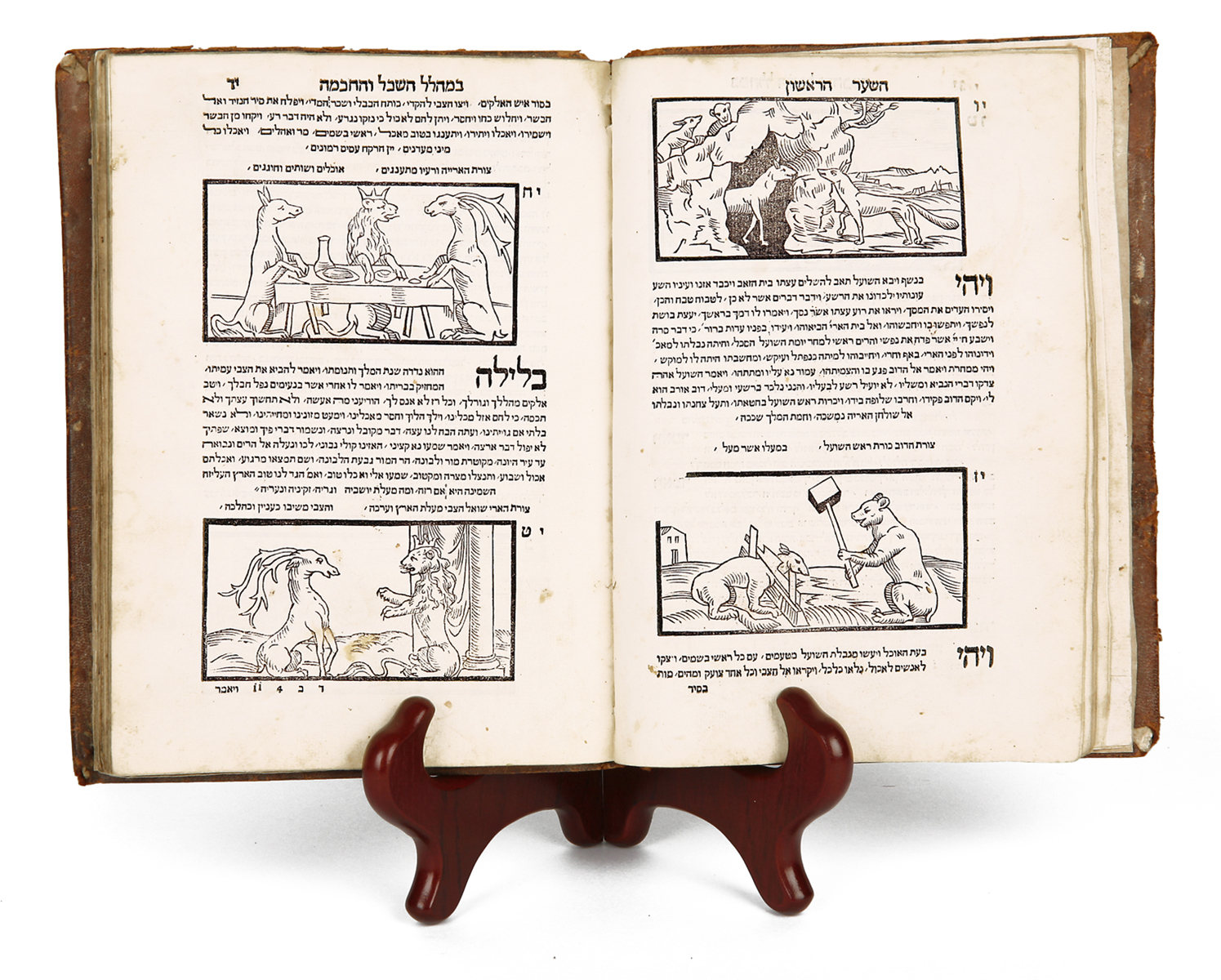
Third edition. Eighty unusual woodcut illustrations (few repeated). Printer’s device on title (Yaari, Hebrew Printers’ Marks, no. 14). Scattered Hebrew marginalia in old hand
references
Vinograd, Venice 319; Adams I-180 (incomplete); A.M. Habermann, Kiryat Sepher vol. XXIX pp. 199-203; Amram, pp. 367-71; Roth, Jewish Art cols. 476-77; Pierpont Morgan Library, Hebraica from the Valmadonna Trust (1989) no. 32; National Library of Canada, The Jacob M. Lowy Collection (1981) no. 111; New York Public Library, A Sign and a Witness (1988) no. 181
summary
“The illustrated Hebrew book par excellence.” A.J. Karp, From the Ends of the Earth: Judaic Treasures of the Library of Congress (1991), p. 125.
Venetian edition of a thirteenth-century collection of allegories, fables and puns with moral inferences all written in rhymed prose. The intention of the rhymed prose was to demonstrate that the Hebrew language was a suitable vehicle of entertainment. Ibn Sahula (b. 1244) uses animal fables as a means of moral allegory. Though this method was common in Arabic literature, Ibn Sahula explains in his introduction that he is not a mere imitator of Islamic writers, for the Bible itself contains numerous fables and parables that served as models for his tales. He cites as examples of this genre, the parable of Jotham (Judges xi. 8-15), as well as the parabolic reponse of King Jehoash of Israel to King Amaziah of Judah’s request for an alliance (II Kings xiv. 9).
The book takes the form of a dialogue between the author and an opponent. The opponent attempts to prove that the cultivation of virtue is worthless, while the author defends the necessity of each virtue, both sides employing animal fables as a means of expressing their ideas. The animals’ lengthy discourses on matters scientific and philosophical, express the author’s views on all branches of knowledge. Thus, in one portal a deer delivers a discourse on the classification of the sciences, and in another, a dog expounds upon the principles of psychology. The dialogues are replete with references to Bible and Talmud. The style of the work imparts a charm and naivete which affords amusement as well as instruction.
The Author illustrated his original manuscript now lost) in order to attract the interest of youth. Almost all the extant medieval manuscripts of the work contain illustrations apparently following the original. For this reason, the printed editions of Meshal Hakadmoni include more than eighty remarkable illustrations. The illustrations are of specifically Jewish origin.
The first printed edition of the Meshal ha-Kadmoni (Brescia, 1491) was the first illustrated Hebrew book. See EJ, Vol. XIV, cols. 656-7 (illustrated)
ff. 64. Title tape repaired, stained. Contemporary blind-tooled calf, scuffed, spine starting. Sm. 4to
Enquire about this lot