
Auction 36 · Lot 185
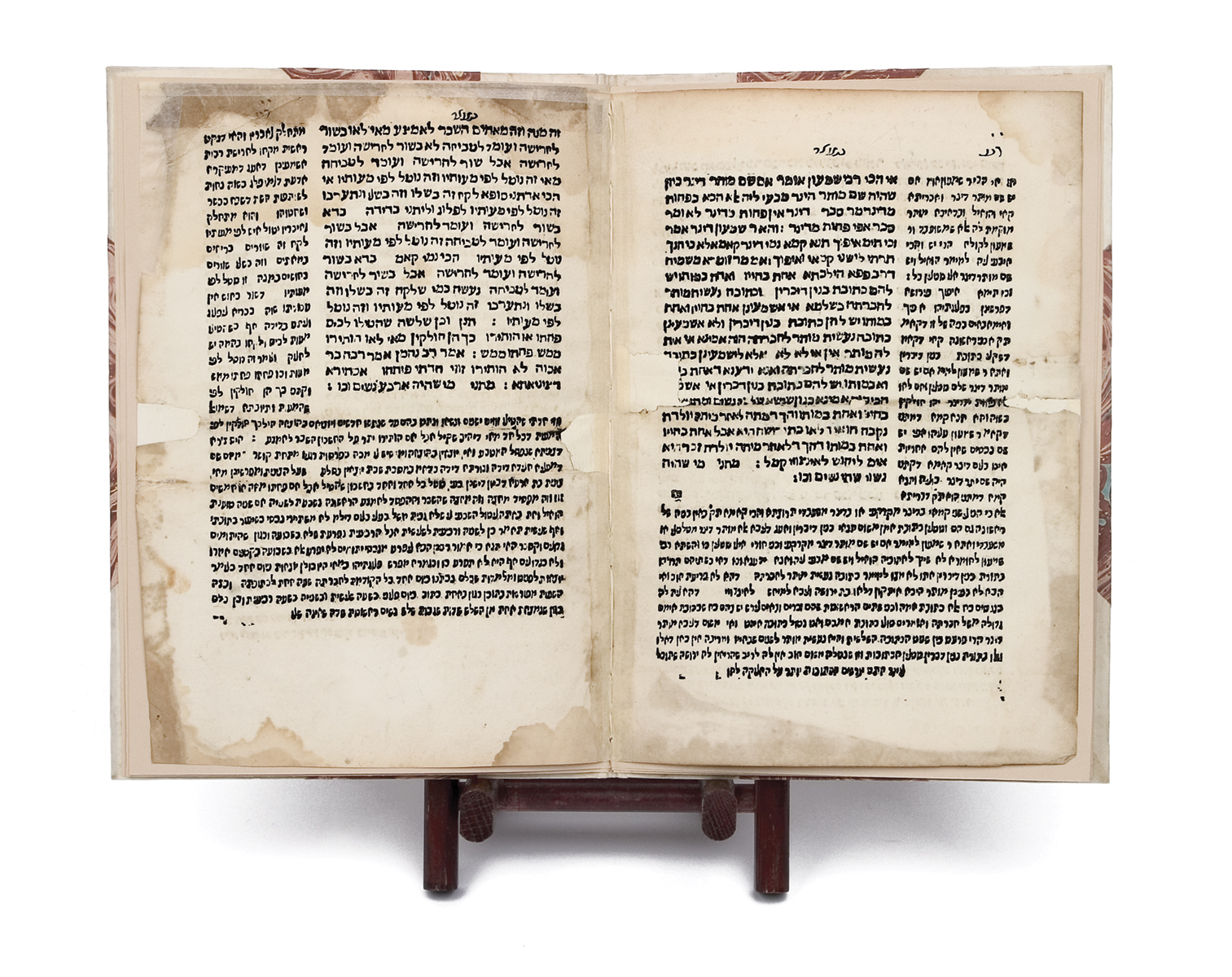
Masechta Kethuboth
- Estimate
- $20,000–$30,000
- Hammer price
- $30,000
Historical auction record. Hammer prices exclude buyer’s premium and taxes.
author
(TALMUD, BABYLONIAN).
printer
(Solomon ben Moses Alkabetz HaLevi )
Place
(Guadalajara)
Publication
(Ca. 1480-1485)
Description
Two leaves containing the text of Folios (daf) 90b - 91a and 93b - 94a
references
Goff-Heb 112; Offenberg 128;
summary
Early Spanish Talmud Fragments of Extreme Rarity.
Due to the mass destruction of Hebrew books as a result of the Spanish Inquisition and Expulsion, Spanish incunabula are notoriously rare.
Most of the Guadalajara Talmud fragments extant only survived as they were discovered within the bindings of other books, used for no other reason other than scraps. Discovering just such a Spanish fragment elicited the following frisson of excitement from the esteemed Librarian of Hebrew Union College: “The rarest books, understandably, (are) those from Spain and Portugal. The acquisition of any Hebrew incunabulum is...noteworthy, and the library is proud to report the acquisition of... albeit a fragment." (H.C. Zafren, Studies in Bibliography and Booklore Vol. XII (1979) p. 45).
Marvin Heller states: “The rarity of the Guadalajara imprints can be appreciated by reviewing the scant holdings...in both public and private collections.”(Printing the Talmud, p. 28).
According to Offenberg, only three fragments exist of this incunable. According to Dimitrovsky’s study of the various fonts used in Guadalajara, Kethuboth was among the last of the Guadalajara Tractates to be published.
Joshua Bloch and Alexander Marx conjectured that variances in the Spanish Tractates probably derived from accurate old manuscripts which came to Spain from the Geonic academies in Babylonia. Indeed, Dimitrovsky states in his introduction (pp. 9, 13), that the significant variances he found in both the text of the Talmud and Rashi, led him to collect all known fragments and publish them with a scholarly introduction for the benefit of Talmudic scholars.
Indeed after a careful comparison, one notes even these unicum leaves, presently offered, contain minor variances from the standard text published in the Vilna Shas, including punctuation and orthography.
See H. Z. Dimitrovsky, Sridei Bavli (1979) Vol. I: Introduction, pp.41-43; and Vol. II: 296a, 296d
Some staining and repair affecting a few words. Handwritten notation in a later hand. Housed in modern half-vellum marbled boards. Folio
Enquire about this lot