
Auction 35 · Lot 256
(ISRAEL, STATE OF)
- Estimate
- $25,000–$30,000
- Hammer price
- Not recorded
Historical auction record. Hammer prices exclude buyer’s premium and taxes.
Place
(Jerusalem)
Publication
1946-47
Description
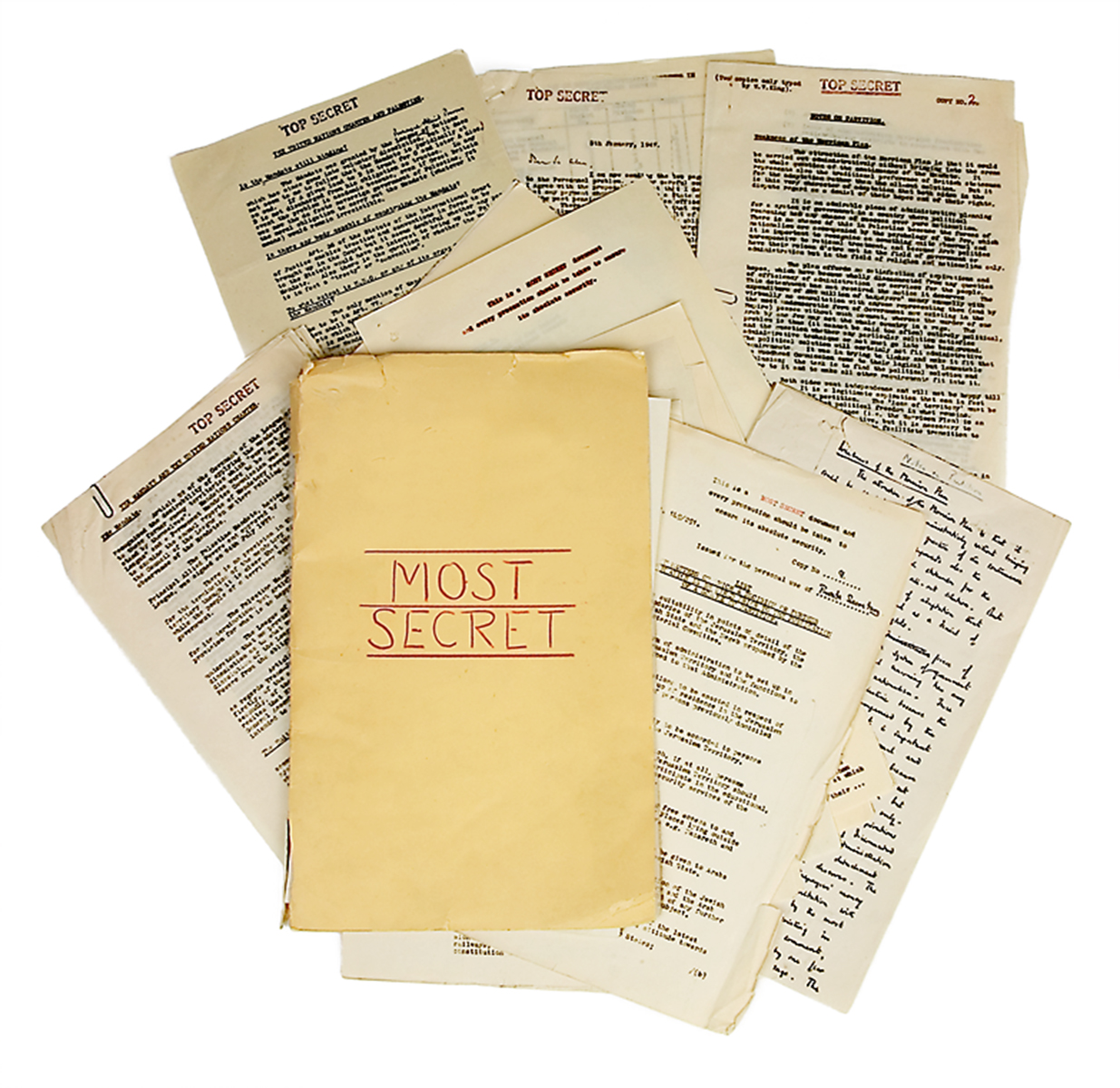
“Most Secret“ Papers of British Mandatory Government concerning the proposed Partition of Palestine.
Including: How to terminate the Mandate. * A timetable for the order of events leading to final Partition. * Treaties needed to be implemented. * Where the boundaries of proposed States are to be drawn. * The assumed reactions to the partes involved, etc
summary
The Last Gasp of the British Mandate of Palestine
These papers are of utmost importance to the historical understanding of the transitional period leading up to the establishment of the State of Israel, and have bearing on the situation in the Middle East to this very day.
At the conclusion of World War II, several successive committees attempted to chart the future of the region in a way acceptable to both Jewish and Arab nationalist aspirations. With the passage of time, Britain reluctantly came to the conclusion that the days of the Mandate were numbered. At a loss to move matters forward, ultimately the British Government dropped the whole mess in the lap of the newly-formed United Nations Organisation (UNO). Our papers deal with London’s increasing frustration with the rapidly deteriorating situation. They also reveal how radical were British plans for carving up the region and how very little territory was to be awarded the Jewish State once it emerged after the transition period. Some of the highly classified documents reveal the deep-seated prejudice of British officialdom. This is borne out in thinly-veiled derogatory statements such as one concerning the “psychology of the Jew, which it is important to recognise as something quite abnormal and unresponsive to rational treatment” (p.1).
One memorandum, dated 5th January, 1947, to “Sir Alan [Cunningham]” (1887-1983), the British High Commissioner of Palestine between the years 1945-1948, concerns the eventual placement and pensioning of British officers in the Palestine Service once the British Mandate has ceased to exist.
Another, undated memorandum, appears to be a legal brief or considered opinion by an authority on international law as to whether the Palestine Mandate is still binding even after the dissolution of the League of Nations, the body which granted the Mandate to Great Britain. Also discussed is whether the United Nations Organisation provides for a Trusteeship to replace the Mandate.
An extremely detailed memorandum, “issued for the use of His Excellency” (Cunningham?), designated Questions 1-24, probes from many different angles - administrative, demographic, economic, legal, military, political, religious, etc. - what the succession States will look like.
In general, the thrust of our memoranda stamped “Secret”, is the carving of Palestine into three entities: A Jewish State, a “Jerusalem State” (over which the British would retain control), and an Arab territory to be subsumed under the sovereign state of Trans-Jordan, ruled over by Amir Abdullah. Thus, our memoranda lay the groundwork for the revised version of the Morrison-Grady scheme put forward by Bevin in January 1947.
An especially sensitive issue was when to break the news of the forthcoming Jewish State to the Jewish Agency, which was to be recognized as the Transitional Administration of the Jewish State. The proposal states rather matter of factly that “there is little purpose in consulting the Agency more than a few hours before the announcement”! (p.2)
Most of the documents set out for whom they were actually written, which shows that there were only 6 or 7 copies made.
There follows a brief dateline of the period under consideration:
January 1946 - The establishment in Washington of the Anglo-American Committee of Inquiry. British Foreign Secretary Ernest Bevin of the Labour government is highly prejudiced against the project from the onset. Its findings are published April 1946. The Committee recommends not partition but rather a bi-national Palestine state, and the immediate immigration of 100,00 Jewish refugees. Rejected by the British government.
September 1946 - British government submits new proposal, the Morrison-Grady Plan (headed by Deputy Prime Minister Herbert Morrison of Britain and Ambassador Henry F. Grady of the U.S.), providing for the division of Palestine into three sectors, Jewish, Arab and British (the latter including Jerusalem and the Negev), with the British retaining supreme control for another four years. Both Arabs and Jews reject the proposal.
January 1947 - Second round of talks in London. Amended version of Morrison-Grady scheme put forward by Bevin. Rejected by Arabs.
February 1947 - The British government announces that it is handing the Palestine problem over to the United Nations.
See EJ, Vol. IX, col. 359; Vol. XVI, cols. 1090-1