
Auction 35 · Lot 255
(ISRAEL, LAND OF)
- Estimate
- $7,000–$10,000
- Hammer price
- $6,000
Historical auction record. Hammer prices exclude buyer’s premium and taxes.
printer
September 28
Place
Tel-Aviv
Publication
1934
Description
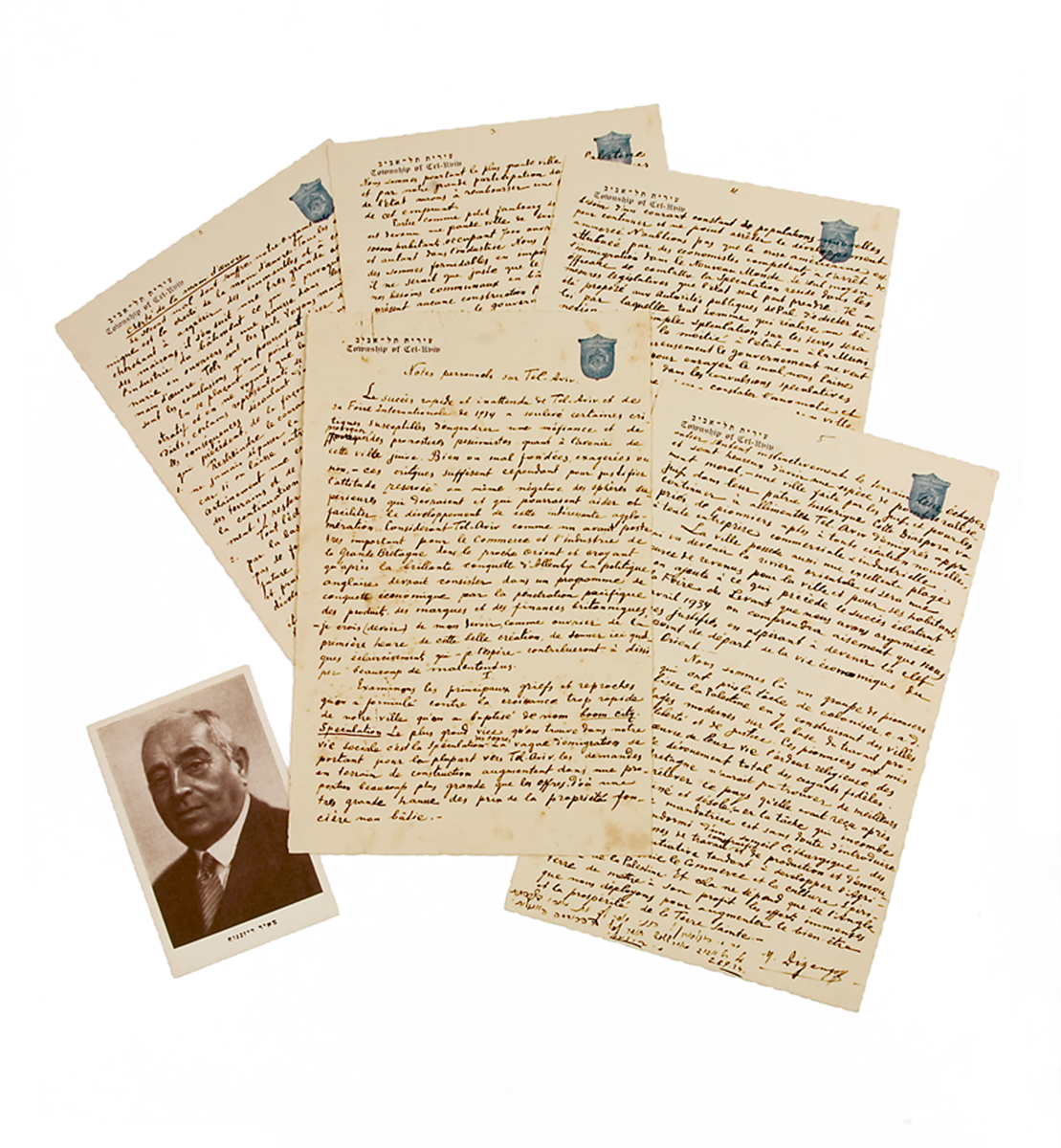
Dizengoff, Meir. Autograph Letter Signed in French, to Mr. M. Fogelsohn, postcript in Hebrew.
Notes Personnels sur Tel-Aviv [“Personal notes on Tel-Aviv”]. Mounted with period postcard displaying likeness of Meir Dizengoff. Included as collateral, two letters from Dr. M. Altbauer, Director of the Historical Museum of Tel-Aviv to the addressee Mr. Menachem Fogelsohn, requesting photocopies of Dizengoff’s French article (January and February 1963)
summary
“Tel-Aviv, as a Jewish city and a Jewish center, is a necessity for the Diaspora; the Jews dispersed, persecuted and menaced throughout the world sense instinctively that the ground is vanishing [under their feet], and are happy to have a rallying point - a city created by Jews, for Jews in their historic homeland” - Meir Dizengoff
In this memoir, which as the Hebrew postscript indicates, served as a form of manifesto, Meir Dizengoff, founder and mayor of the first modern Jewish city, responds here to the many criticisms levelled against this “boom city” (English in original) - which even as he wrote, numbered 6,000 buildings and close to 100,00 inhabitants.
Founded as a small suburb of Jaffa in 1909, the realization of the vision of Tel-Aviv came about with great speed. Nevertheless, the city was subject to much criticism from detractors in the British colonial administration, suspected for their jaundiced view of the Zionist enterprise. Chief of their complaints was the rampant speculation on real estate. Other complaints included the shortage of manpower and the lack of a solid economic base.
Dizengoff rails against the gross unfairness of British policy. Enormous loans were extended to other cities in Palestine, while Tel-Aviv, the largest city of all, received none. In Jaffa, the Administration constructed a "palatial post office ten times greater than the needs of the local population, while the post in Tel-Aviv is housed in small rented quarters!" In Haifa, a courthouse was constructed, while none in Tel-Aviv. Britain’s solution to the problems besetting Palestine the limitation of Jewish immigration. Dizengoff recognized the proferred “solution” for what he really saw it to be - a stranglehold on Jewish aspirations in Palestine.
Dizengoff praises Tel-Aviv’s beautiful beaches that have the potential of developing into the “Oriental Riviera.” According to Dizengoff, the International Fair held in Tel-Aviv in April 1934, justified the hope that the city would one day become “the key and the depature point of the economic life of the Near East.”
In closing, Dizengoff calls upon Great Britain to avail itself of the idealism and zeal of the Zionist pioneers in civilizing Palestine. “Great Britain could not have found better agents for uplifting this land which it received after the War ruined and desolate.”
Meir Dizengoff (1861-1937) was born in Bessarabia, studied chemical engneering in France, and finally settled in Jaffa in 1905. Dizengoff was one of the founders of the Achuzath Bayith Company responsible for establishing a modern Jewish quarter near Jaffa, later known as “Tal Aviv.” In 1921, when Tel Aviv became a city, Dizengoff was elected its first mayor, and served in that capacity virtually until the end of his life.
See Ilan Shchori, Tel Aviv: The Dynamics of a Dream (1990); EJ, Vol. VI, cols. 138-9
A MOST SIGNIFICANT LETTER CONCERNING THE FLOWERING OF TEL AVIV, WRITTEN BY ITS' MOST CHARISMATIC FOUNDING FATHER