
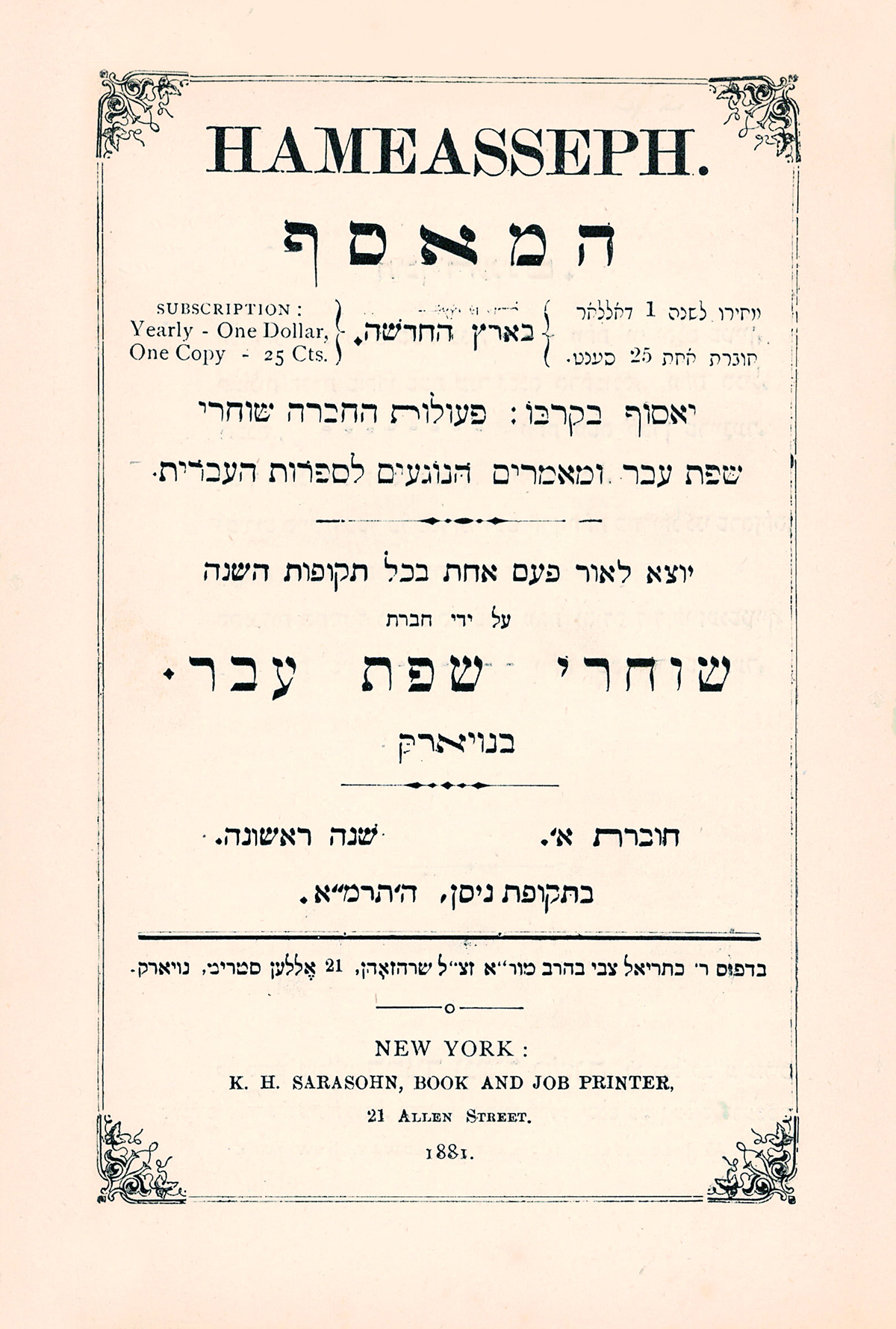
Auction 32 · Lot 17
Hameasseph ba-Aretz ha-Hadashah, Nissan 1881 (All published)
- Estimate
- $2,000–$2,500
- Hammer price
- Not recorded
Historical auction record. Hammer prices exclude buyer’s premium and taxes.
author
(AMERICAN JUDAICA)
printer
Kasriel Hirsch Sarasohn
Publication
1881
references
Singerman, S465
summary
Hameasseph ba-Aretz ha-Hadashah was published by the Society of the Friends of the Hebrew Language (Shoharei Sefat Ever). Founded in 1880 in New York by East European immigrants, it was the first society in the world dedicated to promoting the Hebrew language, “it served as a model for the East European Hebrew intellectuals who founded similar societies during the 1880s in such cities as Chicago and Rochester.” See Jacob Kabakoff, “The American Hamesassef,” Jewish Book Annual 38 [1980-1]: 42-6.
The goal of the New York society was “to awaken a love for our holy language in the hearts of the rest of our brethren who reside in this city who, though familiar with the Torah and hear the Hebrew language, unintentionally do not make an effort to meditate upon books printed in that language. Also to arouse fathers…to teach their children the Hebrew language and Jewish literature…The foundation of our religion in this city becomes weaker on a daily basis, and from year to year, as Reform becomes stronger and more popular among the youth. And this is only because our children are raised in their childhood not even hearing the prayers that were transmitted to us in Hebrew from the Men of the Great Assembly…we are obligated and commanded to strengthen the study of the Hebrew language among our children who are born in the land so that they will not learn the ways of the Reformer” (p. 5). Ironically, the Society’s most important patron was Jacob Schiff (p. 9), himself a Reform Jew. Only one issue of this short-lived society was published.
Hameasseph was likely edited by Mordechai Johalomstein, a immigrant from Poland and a pioneer of the Yiddish and Hebrew press in America. When he died in 1897, “he was characterized in both the Yiddish and Hebrew press as the most learned among the immigrant writers of his time” (Kabakoff, 44)
pp. 44. Unbound. 8vo
Enquire about this lot