
Auction 26 · Lot 64
RaMBa”M). Mishneh Torah [Code of Law]
- Estimate
- $25,000–$35,000
- Hammer price
- Not recorded
Historical auction record. Hammer prices exclude buyer’s premium and taxes.
author
MOSES BEN MAIMON (MAIMONIDES).
printer
Printer Unknown
Place
(Iberian Peninsula)
Publication
circa 1480
Description
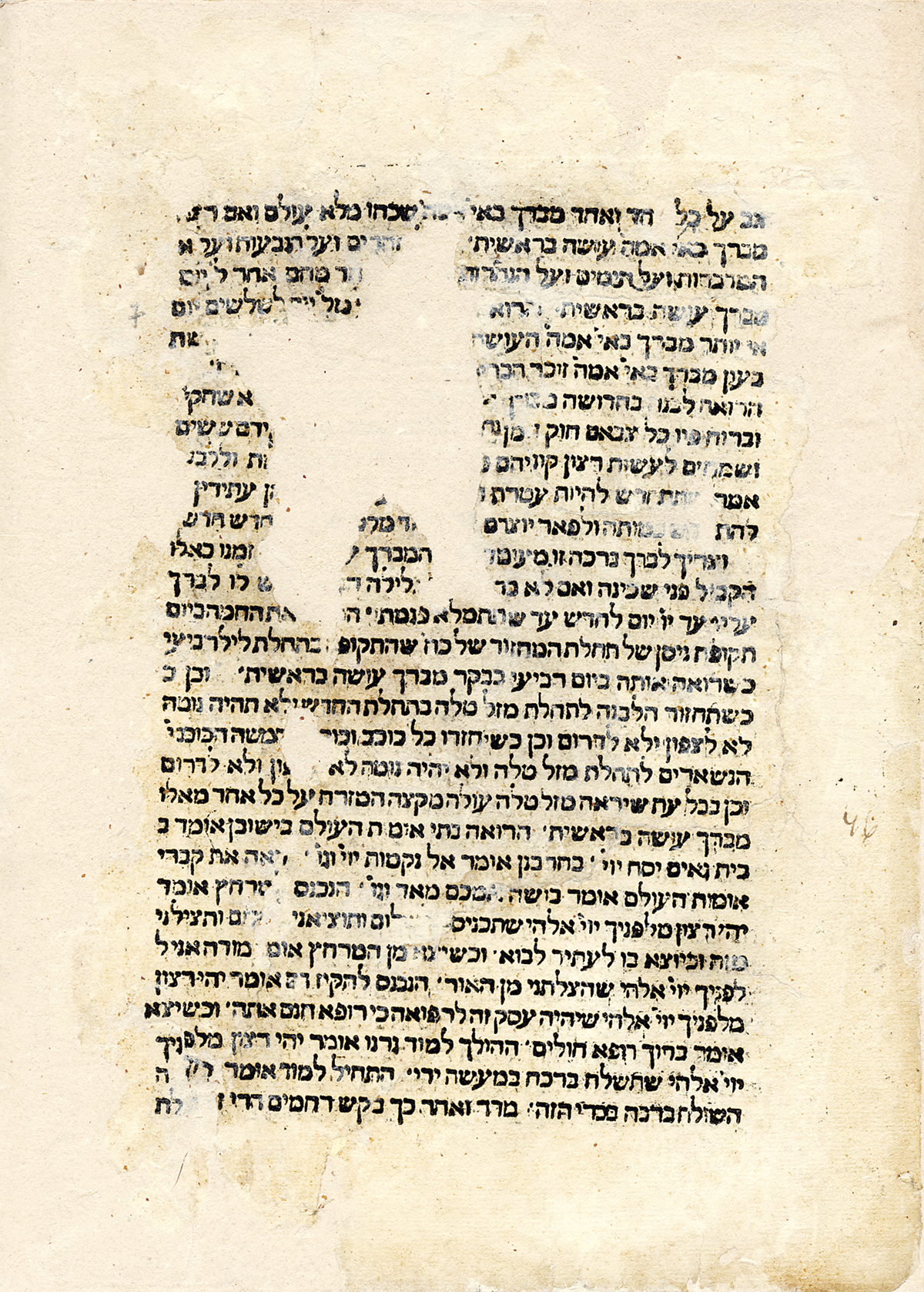
Two slim volumes. Vol. I: f.1, Hil. Tefillin 4:26 - Hil. Mezuzah 6:2; f.2, Hil. Sepher Torah 8:4; ff.3-8, Hil. Berachoth 8:14-15:16, Hil. Milah 1:12; f.9, Hil. Milah 2:6-3:9. * Vol. II: Single leaf of Hil. Berachoth 11:3-15
references
Goff 79,1; Goldstein 103 (listing only one copy in the British Isles - the present, Wineman copy); Offenberg 90; Thes. B36; Wineman Cat. 64. Not in Vinograd or Steinschneider. Not in HUC; Cambridge with fragment of one leaf; JNUL with fragment of 2 leaves; JTS with fragment of 10 leaves. Offenberg records a further five libraries with fragments only (none larger than 10 leaves)
summary
FRAGMENTS OF UNKNOWN EDITION OF MAIMONIDES' MISHNEH TORAH
There are only 23 leaf fragments known to exist worldwide and one of our leaves (f.1) is a unicum. The printer of this book is believed to have printed at least five other texts in Spain including Alfasi's Halachoth. As such, Offenberg classifies this book as a Spanish incunable with no place or date.
Professor Elazar Hurvitz has been tempted to attribute this book and others similar, to Juan de Lucena. According to Inquisitorial records it is clear that the Marrano Juan de Lucena and his daughters printed a variety of Hebrew works from around 1475 to 1479, making de Lucena the first Hebrew printer in Spain and very nearly the first printer of any type in the Iberian peninsula. The relatively simplistic layout here certainly suggests an early date. Similarly, two other pioneers of printing, Alkabetz of Guadalajara and Garton of Regio, printed their books in a single column without pagination. One recalls that Obadiah and partners' Roman books are also strikingly simple in layout. A novice printer would utilize the most basic method possible before attempting more adventurous layouts. See Bloch pp. 11-18, 52-54.
These fragments in the Wineman Collection stem from the binding of a Yemenite book. The imprint of some Yemenite writing is visible on one of the leaves (f.1) and legible when held in a mirror. Other fragments of this edition of Mishneh Torah were discovered in the Cairo Genizah and are presently found in the Taylor-Schechter Genizah Collection in Cambridge
Vol. I: ff.9, plus minute fragments. Vol. II: single leaf. 30 lines per page. All leaves incomplete. Second booklet, duplicate of leaf in first booklet. Modern vellum-backed boards. 29 x 20 cm. Folio
Enquire about this lot