
Auction 26 · Lot 11
(RaLBa”G). Commentary to the Pentateuch
- Estimate
- $70,000–$80,000
- Hammer price
- $90,000
Historical auction record. Hammer prices exclude buyer’s premium and taxes.
author
LEVI BEN GERSHOM (GERSONIDES)
printer
Abraham ben Solomon Conat with Yedidyah Ha’ezrachi of Cologne
Place
(Mantua or Ferrara?)
Publication
(1474-6)
Description
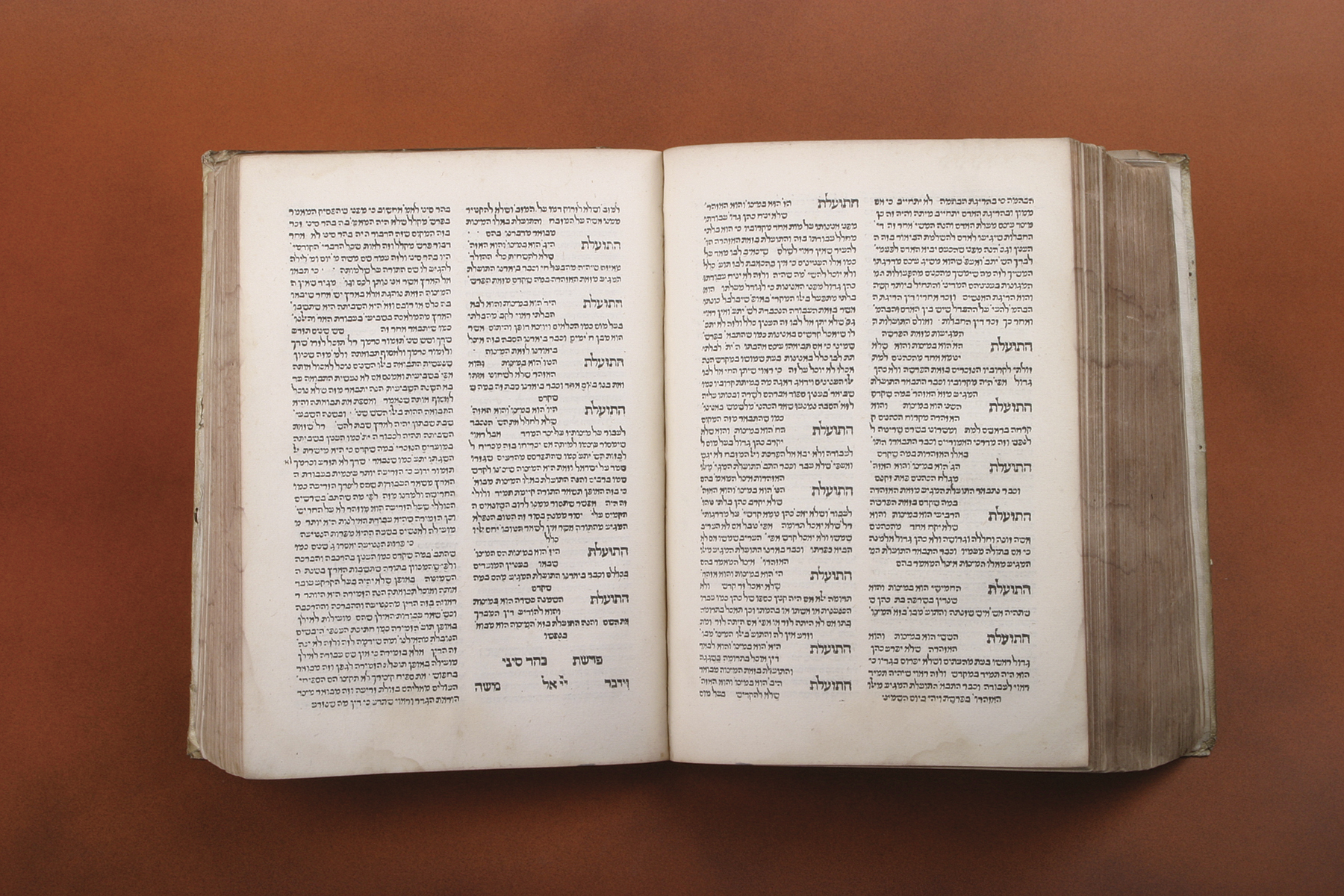
FIRST EDITION. Double columns. The font is Italian semi-cursive. On final page, signature of censor, “Camillo Jaghel, 1619.” Jaghel, as his surname indicates, was an apostate Jew. See Wm. Popper, The Censorship of Hebrew Books (1969), pp. 100-101, pl. IV, no. 2. Inserted at end two autographed letters in a 19th-century German hand describing the contents of the book and explaining the missing word “Amar” at the beginning.
references
Vinograd, Mantua 6; Goff 69; Goldstein 17; Offenberg 50; Steinschneider, p. 1611, no. 6138, 3; Thes. A10; Habermann, Perakim be-Toldoth ha-Madpisim ha-Ivri’im (1978), p. 7, no. 6; Wineman Cat. 11
summary
EXCEPTIONALLY FINE COPY OF GERSONIDES’ COMMENTARY TO PENTATEUCH.
The Provencal Rabbi Levi ben Gershom (Ralba”g or Gersonides) (1288-1344) wrote this most funadamental philosophical commentaries to the Pentateuch. After breaking the language barrier with a matter-of-fact Biur HaMiloth (Explanation of Words), the exegete launches into philosophical essays. A specialty of the commentary are the “To'eleth” or moral lessons to be derived from the particular passage in the Torah.
However, Gersonides’ Commentary was condemned by Judah Messer Leon, the greatest of the Jewish scholars of Mantua, and author of Nopheth Tzufim, another book printed by Conat. In Messer Leon's opinion, Gersonides' portrayal of divine conception as being restricted to generalities, was heretical. The rabbi of Florence, Benjamin Montalcino defended Gersonides. There ensued a heated debate in which practically the entire Italian rabbinate participated. Despite the condemnation of Messer Leon, Conat proceeded with the publication. See I. Rabinowitz, The Book of the Honeycomb's Flow (1983), p. xxxi; S. Simonsohn, History of the Jews in the Duchy of Mantua (1977), pp. 626-7.
Abraham Conat was one of the pioneers of Hebrew printing. The Conats were the first to work as a family unit. Estellina, Abraham’s wife, played a senior role in the management of the press and is mentioned in one of the colophons.
Pietro Adamo de'Micheli introduced printing to Mantua in the year 1472. It is speculated that Conat there learned his craft. Conat, a physician, was also active as a copyist of Hebrew manuscripts. Commenting on the font Conat created, Haberman observes: “The Hebrew letters were cut in accordance with his distinctive handwriting; the readers of his generation would not have immediately discerned the difference between his manuscript and a book printed by him.”
See A.M. Habermann, Studies in the History of Hebrew Printers and Books (1978), p. 3. See further, L. Pescasio, L'arte della stampa a Mantova nei secoli XV-XVI-XVII (Mantua, 1971), p. 11; V. Colorni, “Abraham Conat—primo stampatore di opere ebraiche in Mantova” in: La Bibliofilia 83 (1981).
ff. 403 (of 409? - bibliographers dispute precise collation, ranging from Habermann ff.408 to Vinograd ff. 412). This copy lacks ff.1, 9, 10, 53, 338 (blank) and 408. Dampstained in places, otherwise a fine wide-margined copy. Contemporary vellum, rubbed. Thick folio
Enquire about this lot