
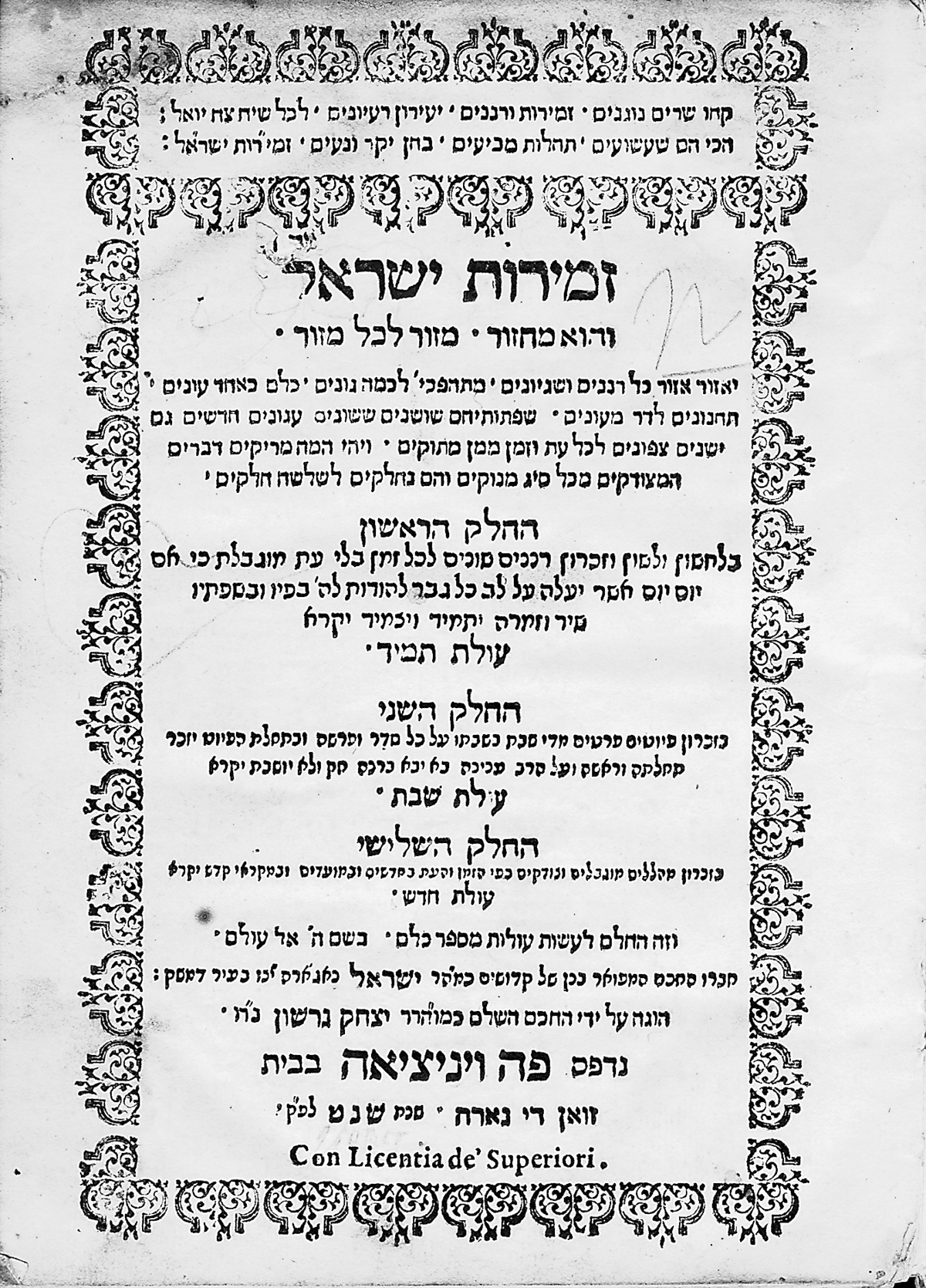
Auction 21 · Lot 189
Zemiroth Israel [religiouspoetry]
- Estimate
- $1,000–$1,500
- Hammer price
- $3,800
Historical auction record. Hammer prices exclude buyer’s premium and taxes.
author
NAJARA, ISRAEL
printer
Giovanni di Gara
Place
Venice
Publication
1599
Description
Three parts subtitled Olath Tamid, Olath Shabbath, Olath Hodesh. Includes separate title page for each part. Hebrew text with instructions in Judeo-Italian. Appended another work Meimei Israel, collected letters by same author, again with separate title page. The latter work ends with brief moral exhortation entitled Mesaheketh ba-Tevel.
At conclusion of third part, 4ff. of manuscript, piyutim (poems) by various authors for holidays, followed by several blank leaves. At end, signature of owner “Elijah ben Asher Malachi Cohen of Monselice, 1793.”
references
Vinograd, Venice 872; Habermann, di Gara 188; Mehlman 1282; not in Adams
summary
First appearance of Ya-h Ribon Olam (f.7r), one of the most popular Sabbath Zemiroth (table hymns) and since set to innumerable melodies.
Najara was the first poet to compose and organize his piyutim according to the Near Eastern “maqam” style of musical composition. Born in Damascus c.1555, his compositions are distinguished by their deep religiosity, references to Jewish suffering and yearning for redemption. Najara learned much from the great Jewish poets of the Spanish-Arabic period, but nevertheless frequently employed original forms and themes. Despite the wide circulation of his poetry, particularly among oriental communities, his occasional imitation of foreign styles and use of erotic terminology was attacked by Menachem di Lonzano and especially Chaim Vital who indeed forbade the singing of Najara’s songs entirely. See I. Zinberg, The Jewish Center of Culture in the Ottoman Empire (1974) pp.94-106; Carmilly-Weinberger pp.217-8; EJ, XII cols.798-9
Israel Najara served as rabbi of Gaza. Upon his death, he was succeeded by his son Moses. Moses’ son, Jacob Najara, inherited the rabbinate of Gaza, and was instrumental in the early days of the Messianic movement surrounding Shabbetai Zevi and his “prophet” Nathan of Gaza. Zevi was especially fond of Israel Najara’s hymns. One of these hymns, Yigaleh Kevod Malkhutho, became a kind of anthem which Sabbatian believers used for over a century. The Frankists, a Polish branch of the Sabbatian movement who converted to Catholicism, sang the Hebrew song “Yiguleh” (Galician pronunciation) within the walls of the Catholic Church in Lublin! See Gershom Scholem in Ignace Goldziher Memorial Volume I (Budapest, 1948), p. 41-44; idem, Sabbatai Sevi, pp. 355-6.
ff.171. Appears to be original binding. Half of spine missing. Slight worming. Condition otherwise good. Sm. 4to
Enquire about this lot