
Auction 37 · Lot 140
(MAPS).
- Estimate
- $600–$900
- Hammer price
- $950
Historical auction record. Hammer prices exclude buyer’s premium and taxes.
Description
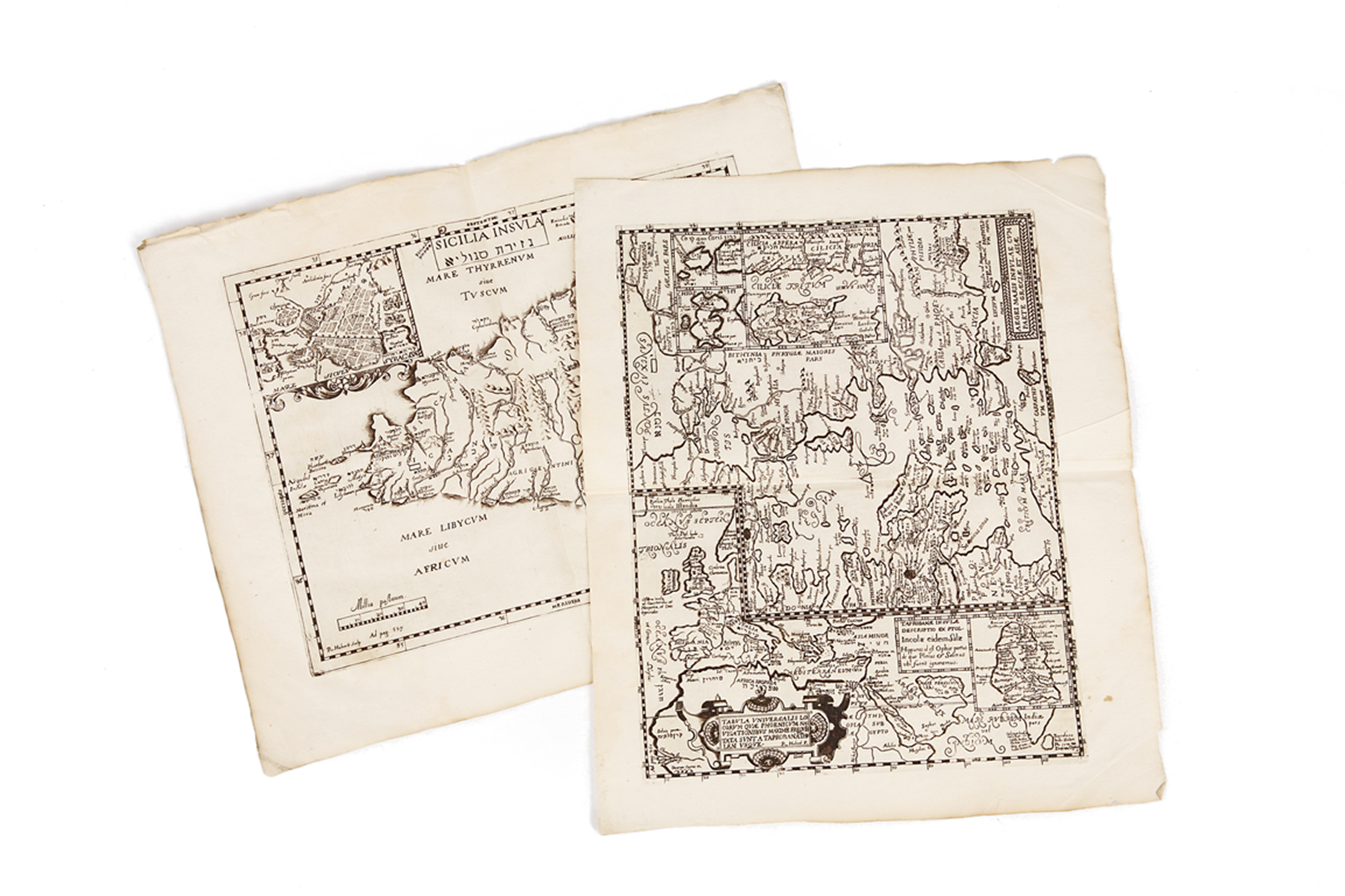
Two maps of Europe with Hebrew lettering:
R. Hubert Sculp. Sicilia Insula / Jazirat Segulia. With inset of city of Syracuse / Karta de-Sircha. 14 x 17 inches.
* R. Hubert F[ecit]. Aegei Maris Insulae cum Parte Graeciae et Asiae [Isles of Aegean Sea with part of Greece and Asia]. With insets: Tabula Universalis Locorum quae Phoenicum Navigationibus Maxime Frequentata… [Table of locations which the Phoenicians frequently navigated]. The inset stretches from Hibernia [Ireland] in the West to India in the East. 14 x 17 inches
summary
It appears that both maps were printed in Samuel Bochart, R. Hubert, Geographiae sacrae pars prior Phaleg. (Caen: 1651). (See E. & G. Wajntraub, Hebrew Maps of the Holy Land (1992), p.55, no.22).
Many of the Hebrew versions of the various locales seem surprising, but upon closer examination, some of these designations are actually quite logical. For example, the heading for the Map of the Island of Sicily at first blush is ridiculous: “Gezeirath Segulia” signifies nothing in pure Hebrew. However, in Arabic “Jazirat” means “the island of…” (Since the Hebrew characters are unvocalized, it is equally valid to read “Jazirat” as “Gezeirath.”) Likewise, “Karta de-Sircha” would appear to be an attempt to approximate a Phoenician rendition of Syracuse. It is well known that the original name of Carthage, which was originally colonized by Phoenicians, was “Kart Chadasht” (i.e. New City). Karta in both Phoenician and Aramaic (languages closely related to Hebrew) signifies “city.” At various times in ancient history, Sicily was a Carthaginian colony